28kHz vs 40kHz Ultrasonic Cleaner: Which Frequency Is Right for Your Parts?
Author: GT SONIC
Date: 2026-10-15
Read: 7 min
28kHz vs 40kHz Ultrasonic Cleaner: Key Differences
The main difference between 28kHz and 40kHz ultrasonic cleaners is how the ultrasonic frequency influences cavitation behavior.
At 28kHz, larger cavitation bubbles generally produce more forceful cleaning action. At 40kHz, smaller bubbles provide a less aggressive cleaning effect, which can be beneficial for components with intricate features or sensitive surfaces.
The following table compares their typical industrial cleaning characteristics.
| Comparison | 28kHz Ultrasonic Cleaner | 40kHz Ultrasonic Cleaner |
|---|
| Cavitation characteristics | Larger, more energetic bubbles | Smaller, generally gentler bubbles |
| Cleaning action | More aggressive | More moderate |
| Suitable contamination | Heavy grease, oil, stubborn deposits | Light to moderate oil, fine particles, machining residues |
| Typical workpieces | Steel, cast iron, heavy machinery components | Precision-machined parts, aluminum components, small mechanical parts |
| Surface compatibility | Better suited to robust surfaces | Generally preferable for more sensitive surfaces |
| Complex geometries | Effective on accessible, durable surfaces | Often suitable for detailed features and narrow openings |
| Main consideration | Potential surface damage from excessive cavitation | Potentially insufficient cleaning action for highly persistent contamination |
How Does Ultrasonic Frequency Affect Cavitation and Cleaning Performance?
Ultrasonic cleaning uses cavitation, a process in which sound waves generate microscopic bubbles that form and collapse rapidly in a cleaning liquid. This action creates localized forces that help loosen and remove contaminants from workpiece surfaces.
Ultrasonic frequency influences bubble size and collapse intensity, affecting both cleaning effectiveness and material compatibility. The key difference between 28kHz and 40kHz is how they balance cleaning strength and surface protection.
1. Cavitation Intensity at 28kHz
At 28kHz, cavitation bubbles are generally larger and collapse with greater force, producing a more aggressive cleaning action. This makes the frequency effective for removing stubborn grease, machining residues, and deposits from durable industrial components.
For example, heavily contaminated steel machinery parts may benefit from 28kHz cleaning. However, stronger cavitation can increase the risk of surface erosion, particularly on softer metals, delicate coatings, or precision-finished components.
2. Cleaning Characteristics at 40kHz
At 40kHz, smaller cavitation bubbles typically produce a gentler cleaning action, making this frequency well suited for removing fine particles, machining oils, and moderate contamination.
Common applications include precision-machined parts, aluminum components, and mechanical assemblies with grooves, narrow openings, or other detailed features.
Although 40kHz generally reduces the risk of cavitation-related damage, cleaning conditions must still be matched to the material and surface requirements.
The ideal frequency is one that achieves the required cleaning results while preserving the workpiece's surface quality.
When Should You Choose a 28kHz Ultrasonic Cleaner?
A 28kHz ultrasonic cleaner is particularly suitable for heavy-duty cleaning applications involving durable metal components and stubborn contamination. It is commonly used for industrial machinery maintenance, where gears, bearings, and other robust mechanical parts may accumulate thick grease, oil, and dirt during operation.
In metalworking applications, 28kHz can help remove cutting fluids, lubricants, and machining residues from compatible steel and cast iron components before further processing or assembly. It is also useful for cleaning durable industrial molds and tooling affected by release agents or production deposits. Similarly, certain automotive engine components, such as metal housings and brackets, may benefit from its stronger cleaning action when thorough degreasing is required.
However, 28kHz is not suitable for every metal surface. Polished finishes, delicate coatings, and softer materials may be more vulnerable to cavitation damage. Workpiece compatibility should be evaluated before selecting this frequency for regular production use.
When Is a 40kHz Ultrasonic Cleaner the Better Choice?
A 40kHz ultrasonic cleaner is often preferred for general industrial cleaning and precision components that require careful surface treatment. It is suitable for removing fine particles, residual cutting fluids, and light to moderate contamination from precision-machined parts where dimensional accuracy and surface quality are important.
Common applications include aluminum housings, brackets, fittings, and small mechanical components such as fasteners and springs. Parts with threads, grooves, or recessed features can also benefit from ultrasonic cleaning, as cavitation helps dislodge contaminants from areas that are difficult to reach through conventional cleaning methods, provided the cleaning liquid can access them.
Although 40kHz generally produces a gentler cleaning action than 28kHz, it does not eliminate the risk of surface damage. Sensitive coatings, delicate finishes, and certain materials still require appropriate cleaning conditions and compatibility testing.
How to Choose Between 28kHz and 40kHz for Different Industrial Parts
Selecting the right ultrasonic cleaning frequency requires more than identifying the workpiece material. The type of contamination, surface finish, and cleaning requirements also influence whether 28kHz or 40kHz is more suitable.
For example, a heavily contaminated steel component may benefit from the stronger cleaning action of 28kHz, while a precision-machined part with a delicate finish may be better suited to 40kHz. Even components made from the same material can require different frequencies depending on their condition and intended use. For guidance on matching tank size, power, and other specifications to your workload, see our guide on how to choose the right industrial ultrasonic cleaner for your business.
| Industrial Application | Suggested Frequency | Main Consideration |
|---|
| Heavy steel components | 28kHz | Stubborn grease and accumulated deposits |
| Cast iron machinery parts | 28kHz | Heavy contamination on durable surfaces |
| CNC-machined aluminum parts | 40kHz | Surface finish and material compatibility |
| Precision mechanical components | 40kHz | Fine residues and surface requirements |
| Automotive engine parts | 28kHz / 40kHz | Component material and contamination level |
| Industrial molds and tooling | 28kHz / 40kHz | Surface coatings and production residues |
| Mixed industrial components | Dual frequency | Different cleaning needs across batches |
These recommendations serve as starting points rather than fixed rules. Parts with coatings, polished surfaces, intricate features, or strict cleanliness requirements may need additional evaluation.
For industrial applications, testing representative workpieces at the intended frequency is the most reliable way to confirm cleaning effectiveness and surface compatibility.
When Should You Consider a Dual Frequency Ultrasonic Cleaner?
A dual frequency ultrasonic cleaner is suitable for manufacturers handling industrial parts with different cleaning requirements. By switching between 28kHz and 40kHz, operators can adjust the cleaning approach to accommodate varying contamination levels and surface sensitivities without relying on separate machines.
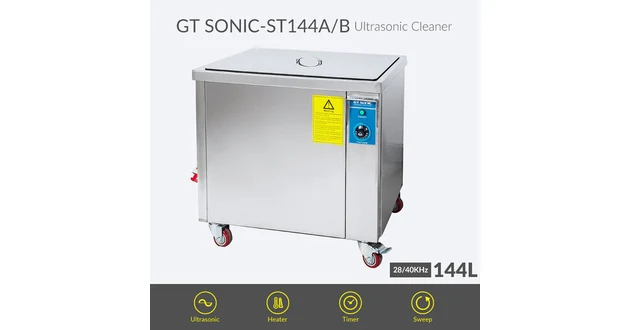
For example, a metalworking facility may use 28kHz for heavily contaminated steel components and 40kHz for precision-machined parts with equipment such as GT SONIC 77L 28kHz/40kHz industrial ultrasonic cleaner. This versatility is particularly valuable for workshops and industrial cleaning service providers processing a wide range of components.
GT SONIC Dual Frequency Industrial Ultrasonic Cleaners
GT SONIC provides industrial ultrasonic cleaning equipment, including dual-frequency configurations designed for diverse parts-cleaning applications. These systems offer flexible frequency selection, helping businesses manage different cleaning tasks while reducing the need for multiple single-frequency units. A representative system is the GT SONIC dual frequency industrial ultrasonic cleaning machine, which combines PLC control with 6000W heating power.
The optimal settings should still be confirmed through workpiece testing to ensure effective cleaning and surface compatibility.
Need an industrial ultrasonic cleaning solution? Contact GT SONIC with your workpiece specifications and cleaning requirements to discuss suitable equipment options.
Frequently Asked Questions About 28kHz and 40kHz Ultrasonic Cleaners
1. Is 28kHz more powerful than 40kHz for ultrasonic cleaning?
Not necessarily. Frequency and ultrasonic power are different specifications. While 28kHz generally produces more intense cavitation, it does not automatically mean higher power or better cleaning performance. Actual results depend on the equipment design, operating conditions, and type of contamination.
2. Can a 28kHz ultrasonic cleaner damage metal parts?
Yes, particularly when cleaning soft metals, delicate coatings, or highly polished surfaces. The stronger cavitation associated with 28kHz may cause erosion or surface damage under certain conditions. Cleaning intensity and exposure time should be evaluated before processing sensitive components.
3. Is 40kHz suitable for cleaning automotive parts?
Yes. A 40kHz ultrasonic cleaner can remove machining oils, fine particles, and moderate contamination from compatible automotive components, including precision-machined parts and certain valve bodies. Suitability depends on the component material, surface treatment, and cleaning requirements.
4. Can a dual frequency ultrasonic cleaner switch between 28kHz and 40kHz?
Yes, if the equipment is specifically designed for 28kHz and 40kHz operation. These systems allow operators to select the appropriate frequency for different cleaning tasks. However, available frequency combinations and switching functions vary by model and should be confirmed before purchasing.
5. Which ultrasonic frequency is better for industrial parts cleaning?
The better choice depends on the workpiece and contamination level. A 28kHz system is generally preferred for aggressive cleaning of durable components, while 40kHz is often suitable for precision parts and less demanding contamination. Testing representative workpieces helps determine the appropriate frequency.
Conclusion
Selecting between 28kHz and 40kHz ultrasonic cleaners requires balancing cleaning effectiveness with material and surface compatibility. While 28kHz is often suitable for stubborn contamination on durable components, 40kHz provides a gentler approach for many precision cleaning applications.
For businesses handling varied industrial parts, dual-frequency equipment offers additional flexibility. As an ultrasonic cleaning equipment manufacturer, GT SONIC provides industrial cleaning solutions for different production needs. Contact us to discuss your workpieces and find a suitable cleaning system.


