Can You Clean a DPF with an Ultrasonic Cleaner?
Author: Zoey
Date: 2026-07-14
Read: 10min
Quick Answer
Yes, a diesel particulate filter can often be cleaned with an ultrasonic cleaner, especially when the blockage is caused by soot, ash, and fine particulate buildup inside the filter channels. However, ultrasonic DPF cleaning is not suitable for every filter. If the DPF is cracked, melted, oil-soaked, structurally collapsed, or repeatedly blocked because of an engine fault, cleaning may not restore it. A proper process should include inspection, compatible water-based cleaning solution, ultrasonic cleaning, rinsing, full drying, and performance checking before reinstallation.
Table of Contents
-What Makes DPF Cleaning Different from Other Parts Cleaning?
-How Ultrasonic DPF Cleaning Works
-When Can a DPF Be Cleaned with an Ultrasonic Cleaner?
-When Ultrasonic Cleaning May Not Save a DPF?
-Can I Put Diesel in an Ultrasonic Cleaner?
-Ultrasonic DPF Cleaning vs Thermal, Air, and Aqueous Methods
-Step-by-Step Ultrasonic Cleaning Process for DPFs
-Choosing the Right Ultrasonic Cleaner for Diesel Particulate Filters
-FAQ About Ultrasonic DPF Cleaning
-Conclusion
Introduction
A diesel particulate filter, also known as a DPF, is designed to capture soot and particulate matter from diesel engine exhaust. When the filter becomes blocked, exhaust back pressure may increase, engine power may drop, fuel consumption may rise, and regeneration may fail more often.
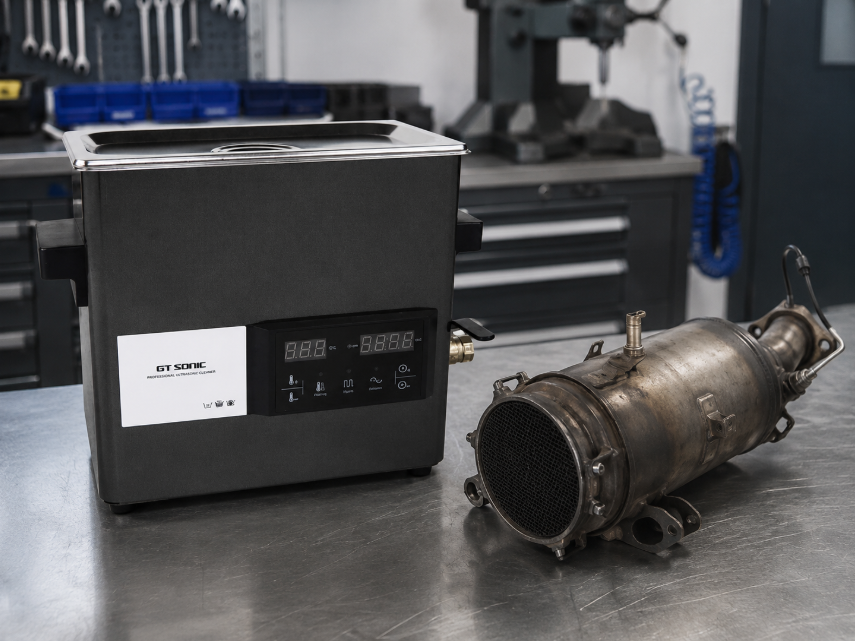
For workshops, fleet maintenance centers, and diesel repair service providers, DPF cleaning is not just a maintenance task. It directly affects vehicle uptime, operating cost, and long-term engine performance. Ultrasonic cleaning is one method used to clean DPFs more deeply, but it should not be treated as a universal solution for every blocked filter.
This article explains when ultrasonic DPF cleaning makes sense, when replacement may be necessary, what cleaning fluid should be used, and how to choose an ultrasonic cleaner for diesel particulate filters.
What Makes DPF Cleaning Different from Other Parts Cleaning?
DPF cleaning is more complex than cleaning ordinary metal parts. A diesel particulate filter has a dense internal structure with many small channels designed to trap exhaust particles. Dirt does not only stay on the surface. It can build up deep inside the filter body.
Soot, Ash, and Oil Contamination Are Not the Same
The first step is understanding what is blocking the DPF.
Soot is mainly produced by incomplete diesel combustion. In many vehicles, normal regeneration burns off a large part of the soot. However, if regeneration fails or driving conditions are poor, soot can accumulate and restrict airflow.
Ash is different. It usually comes from engine oil additives, fuel additives, and metallic particles. Unlike soot, ash cannot simply be burned away during regeneration. Over time, ash collects inside the filter and reduces the available flow area.
Oil contamination is another issue. If a DPF is soaked with oil, it may indicate an upstream engine, turbocharger, or fuel system problem. Cleaning the DPF without fixing the root cause may lead to fast re-blocking.
Why DPF Channels Are Hard to Clean Completely
A DPF is built with many narrow internal passages. These channels are designed to trap particles, which also makes them difficult to clean. Surface washing or compressed air may remove loose debris, but it may not reach deposits trapped deeper in the filter structure.
This is why ultrasonic DPF cleaning is useful in suitable cases. It allows cleaning action to reach internal surfaces through the liquid, helping loosen trapped soot, ash, and residue from small channels.
How Ultrasonic DPF Cleaning Works
Ultrasonic DPF cleaning uses high-frequency sound waves inside a cleaning tank filled with a compatible liquid. These sound waves create microscopic cavitation bubbles in the cleaning solution.
How Cavitation Reaches the Filter Channels
During ultrasonic cleaning, tiny bubbles form and collapse rapidly in the liquid. This process creates small cleaning forces that act on the surfaces touched by the solution. For a DPF, this means the cleaning action can reach the outer surface and internal filter channels when the filter is fully submerged.
The goal is not to scrape the DPF mechanically. Instead, ultrasonic cavitation helps loosen soot, ash, and fine deposits from complex internal areas. This makes it useful for diesel particulate filters because their internal channels are difficult to reach with manual cleaning tools.
Why Water-Based Cleaning Solution Matters
The cleaning liquid is critical. A DPF should not be cleaned in diesel, gasoline, kerosene, or other fuel-based liquids. For ultrasonic DPF cleaning, a compatible water-based cleaning solution is the safer and more practical choice.
The solution should be suitable for DPF materials, metal housings, and ceramic or filter substrates. It should help break down soot, ash, and oily residue without damaging the filter structure. After cleaning, the DPF must be rinsed thoroughly to remove loosened contaminants and cleaning solution residue.
When Can a DPF Be Cleaned with an Ultrasonic Cleaner?
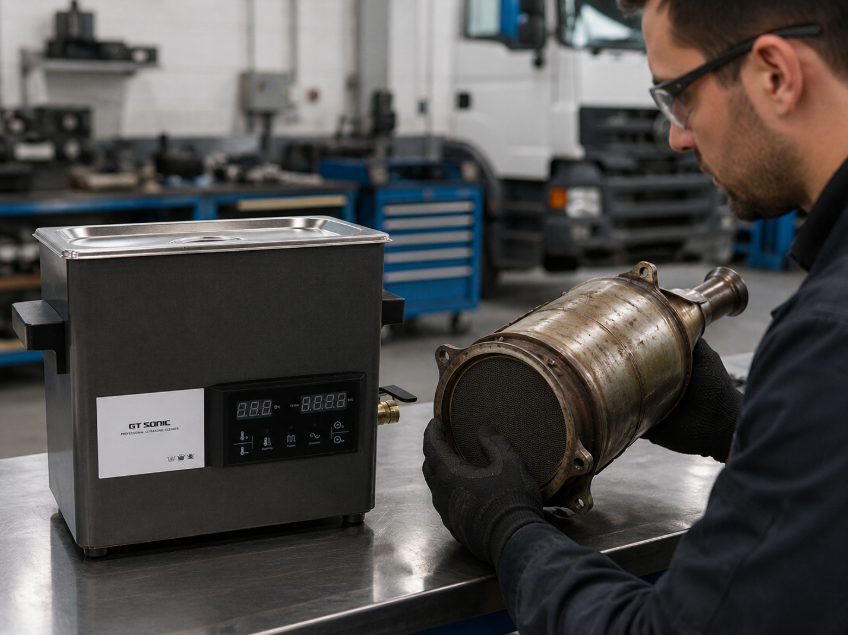
A DPF can often be cleaned with an ultrasonic cleaner when the filter structure is still intact and the blockage is mainly caused by soot, ash, and particulate buildup.
Suitable Cases for Ultrasonic DPF Cleaning
Ultrasonic cleaning is more suitable when:
1.The DPF is structurally complete.
2.There is no visible cracking, melting, or internal collapse.
3.The blockage is caused by normal soot and ash accumulation.
4.The filter has not been heavily soaked with oil.
5.The workshop wants to clean deep internal channels, not just the surface.
6.The DPF can be fully rinsed and dried after cleaning.
For repair shops and fleet maintenance teams, ultrasonic cleaning may help restore airflow and reduce back pressure when the filter is still recoverable.
What Should Be Checked Before Cleaning
Before placing a DPF into an ultrasonic cleaner, inspection is necessary. Check the outer shell for dents, deformation, or leakage. Inspect the filter substrate for cracks, melted channels, loose material, or signs of internal damage.
It is also useful to record the DPF condition before cleaning. Depending on the workshop process, this may include weight, back pressure, airflow, or visual inspection results. These records help determine whether the cleaning process has actually improved filter performance.
If the DPF is blocked because of engine oil burning, turbocharger failure, injector problems, or failed regeneration control, the upstream issue should be solved first. Otherwise, the cleaned DPF may block again quickly.
When Ultrasonic Cleaning May Not Save a DPF?
Ultrasonic cleaning can be effective, but it cannot repair a physically damaged filter. This is an important point for workshops and customers.
Can a Fully Blocked DPF Be Cleaned?
A fully blocked DPF may still be cleanable if the blockage is mainly soot and ash. In this case, professional ultrasonic cleaning, followed by rinsing and complete drying, may help restore flow.
However, “fully blocked” can also mean serious internal failure. If the filter has melted channels, cracked substrate, collapsed structure, or heavy oil contamination, ultrasonic cleaning may not be enough. Cleaning can remove contamination, but it cannot rebuild damaged ceramic material or repair a failed filter core.
Signs the DPF May Need Replacement Instead
Replacement may be the better option when:
1.The filter substrate is cracked.
2.Internal channels are melted or collapsed.
3.The filter body is loose inside the shell.
4,The DPF is heavily contaminated with oil.
5.The same DPF blocks again soon after cleaning.
6.Sensors, regeneration, or engine faults remain unresolved.
7.Airflow or back pressure does not improve after cleaning.
In these cases, cleaning may waste time and cost without solving the actual problem.
Can I Put Diesel in an Ultrasonic Cleaner?
No. Diesel should not be used as an ultrasonic cleaning fluid.
Why Diesel Is Not a Proper Ultrasonic Cleaning Fluid
Diesel is a fuel, not a dedicated ultrasonic cleaning solution. It can leave oily residue on the DPF and may not properly remove ash or deep deposits. It is also not suitable for standard ultrasonic cleaner tanks.
Using fuel-based liquids in ultrasonic cleaning equipment creates unnecessary safety and cleaning risks. A DPF cleaning process should be designed around a proper water-based cleaning solution, not diesel.
What Cleaning Solution Should Be Used for DPFs
For ultrasonic DPF cleaning, use a water-based, low-foam cleaning solution compatible with DPF materials. The cleaner should be suitable for industrial or automotive parts cleaning and should not be strongly acidic, strongly alkaline, or chemically aggressive unless confirmed safe for the specific DPF type.
After ultrasonic cleaning, the DPF must be rinsed until loosened soot, ash, and solution residue are removed. Then it must be dried completely before installation. If the DPF is a special retrofit filter or has unusual materials, confirm whether water-based cleaning is allowed before processing.
Ultrasonic DPF Cleaning vs Thermal, Air, and Aqueous Methods
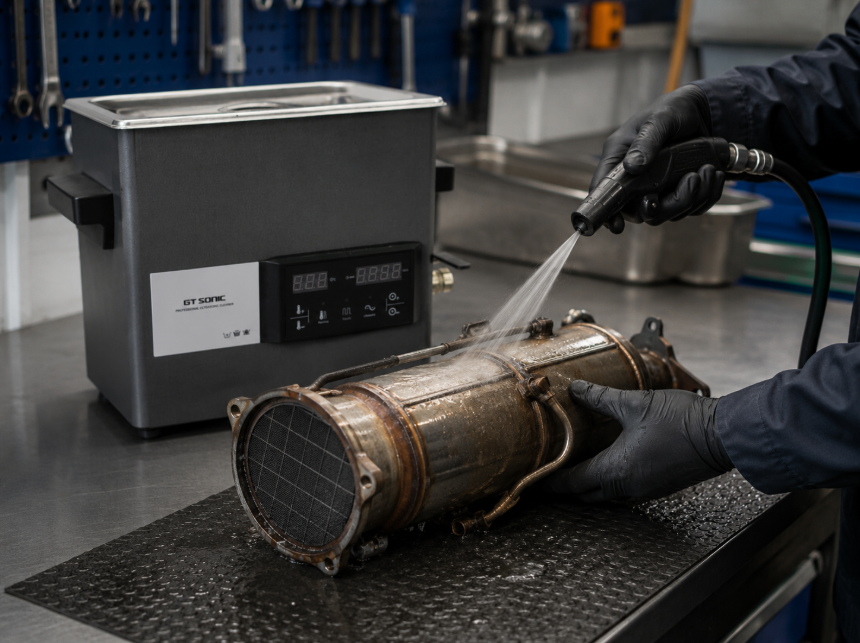
There is no single best DPF cleaning method for every filter. Different methods work in different ways, and workshops often choose based on filter condition, service volume, budget, and required cleaning depth.
Thermal Cleaning
Thermal cleaning uses heat to burn off soot inside the filter. It can be useful for soot-heavy filters, especially when regeneration alone is not enough. However, ash does not burn away like soot. After thermal cleaning, additional air cleaning or other processes may still be needed to remove remaining ash.
Thermal cleaning also requires careful temperature control. If not managed properly, excessive heat may affect the filter substrate.
Air Cleaning
Air cleaning uses compressed air to blow loose particles out of the DPF. It is simple and relatively fast, but it may not fully clean deposits trapped deep inside narrow channels.
Air cleaning is better for loose ash removal than for bonded deposits. It can be part of a maintenance process, but it may not be enough for heavily loaded filters.
Aqueous Cleaning
Aqueous cleaning uses water-based cleaning and flushing to remove contamination from the filter. It can be effective for different DPF sizes and is often used in service workflows that require rinsing and drainage.
The main requirements are proper water handling, filtration, drying, and wastewater management. If drying is incomplete, moisture may remain inside the filter and affect reinstallation.
Ultrasonic Cleaning
Ultrasonic cleaning is strong in deep-channel cleaning because cavitation works through the liquid and can reach internal surfaces. It can reduce manual work and improve cleaning consistency for complex DPF structures.
Its limitations include tank size, equipment investment, cleaning solution compatibility, rinsing requirements, and drying time. For the right DPF condition, ultrasonic cleaning can be one of the most thorough methods, but it should still be part of a controlled process.
Step-by-Step Ultrasonic Cleaning Process for DPFs
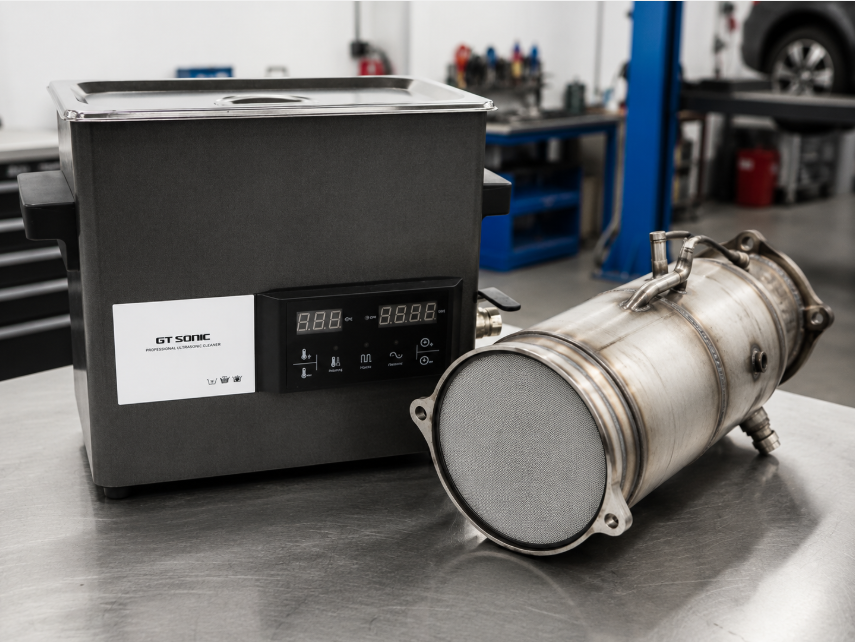
A professional ultrasonic DPF cleaning process should not stop at placing the filter into a tank. The complete workflow matters.
Step 1: Inspect and Record the DPF Condition
Start with visual inspection. Check for cracks, melted areas, loose substrate, oil contamination, and shell damage. If possible, record weight, airflow, or back pressure before cleaning. This creates a baseline for comparison after cleaning.
Step 2: Pre-Rinse or Pre-Treat Loose Contamination
Before ultrasonic cleaning, remove loose ash or surface debris. Some filters may need pre-rinsing or pre-treatment with a compatible cleaning solution. Avoid aggressive high-pressure methods that may damage the filter substrate.
Step 3: Submerge the DPF in the Ultrasonic Tank
Place the DPF in a suitable industrial ultrasonic tank. The filter should be fully submerged in the cleaning solution. The tank should be large enough to fit the DPF without forcing it against the bottom or sides.
Set the cleaning time, power, and temperature according to the filter condition and cleaning solution instructions. For larger DPFs, uniform ultrasonic power distribution is important.
Step 4: Rinse, Flush, and Remove Residue
After ultrasonic cleaning, rinse and flush the DPF thoroughly. This step removes loosened soot, ash, and cleaning solution residue from the internal channels. Skipping this step can reduce cleaning quality and leave contamination inside the filter.
Step 5: Dry Completely and Recheck Performance
A DPF must be fully dried before reinstallation. Moisture left inside the filter can affect performance and may create problems during operation.
After drying, recheck weight, back pressure, airflow, or other performance indicators. This confirms whether the cleaning process achieved the expected result.
Choosing the Right Ultrasonic Cleaner for Diesel Particulate Filters
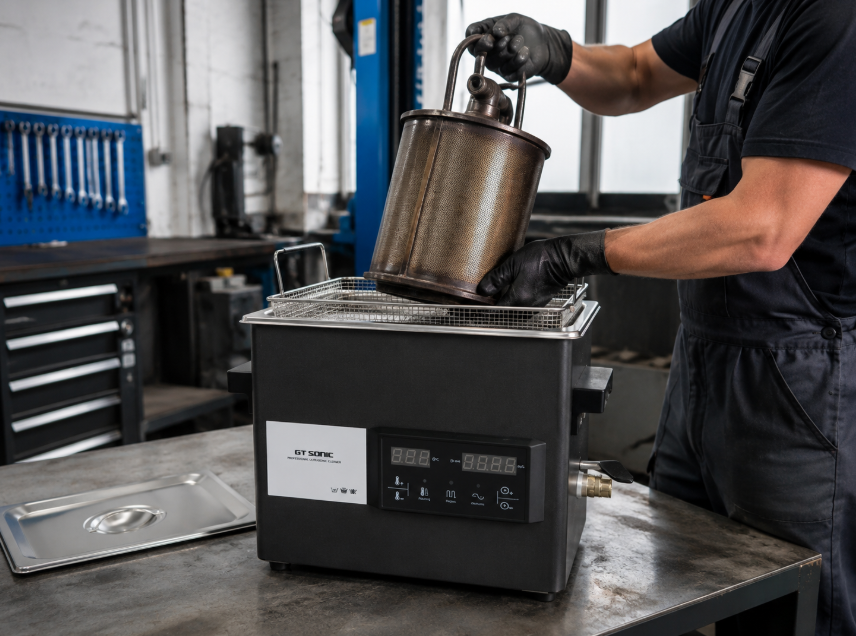
DPFs are much larger and heavier than small automotive parts. A small tabletop ultrasonic cleaner is not suitable for this task. Workshops need industrial equipment designed for larger components.
Tank Size and Load Capacity
The tank must be large enough to fully submerge the DPF. It should also support the weight of the filter and cleaning basket. For repair shops handling different truck, bus, or heavy-duty vehicle filters, tank size and load capacity are key selection factors.
A practical DPF ultrasonic cleaning machine may also need drainage, filtration, lifting assistance, and strong tank construction for repeated workshop use.
Frequency, Power, and Heating Control
Stable ultrasonic power is important for consistent cleaning. The machine should provide even cavitation across the tank, especially when cleaning large filters.
Power and temperature should be controllable. The goal is to loosen contamination without damaging the filter structure. Heating may help the cleaning solution work better, but excessive temperature should be avoided.
Rinse and Drying Workflow
DPF cleaning is not only about ultrasonic action. A complete setup should include rinsing, drainage, residue removal, and drying. For B2B users, workflow efficiency is just as important as cleaning power.
A workshop that cleans DPFs regularly should think about how filters move from inspection to cleaning, rinsing, drying, and final testing.
Who Needs an Industrial DPF Ultrasonic Cleaner?
An industrial DPF ultrasonic cleaner is suitable for:
1.Diesel repair shops
2.Truck service workshops
3.Fleet maintenance centers
4.DPF cleaning service providers
5.Heavy-duty vehicle maintenance companies
6.Engine rebuild and industrial parts cleaning businesses
For these users, the right equipment can improve cleaning consistency, reduce manual labor, and support more efficient DPF maintenance.
FAQ About Ultrasonic DPF Cleaning
1.Can you clean a DPF with an ultrasonic cleaner?,
Yes, if the DPF structure is intact and the contamination is mainly soot, ash, and particulate buildup. If the filter is cracked, melted, oil-soaked, or structurally damaged, replacement may be required.
2.What is the best DPF cleaning method?
There is no single best method for every DPF. Thermal, air, aqueous, and ultrasonic cleaning all have different strengths. Ultrasonic cleaning is useful for deep internal channels, while other methods may fit different service workflows.
3.Can I put diesel in an ultrasonic cleaner?
No. Diesel should not be used as an ultrasonic cleaning fluid. Use a compatible water-based cleaning solution designed for DPF or industrial parts cleaning.
4.Can a fully blocked DPF be cleaned?
Sometimes. If the blockage is mainly soot and ash, professional cleaning may help. If the filter is melted, cracked, collapsed, or heavily oil-contaminated, cleaning may not restore it.
5,Do you need to dry a DPF after ultrasonic cleaning?
Yes. A DPF must be fully rinsed and dried before installation. Moisture or cleaning solution residue inside the filter may affect performance.
Conclusion
A DPF can be cleaned with an ultrasonic cleaner when the filter is structurally intact and the blockage is mainly caused by soot, ash, and particulate buildup. However, ultrasonic cleaning cannot repair cracked, melted, collapsed, or oil-soaked filters.
The safest and most effective process includes inspection, compatible water-based cleaning solution, ultrasonic cleaning, rinsing, complete drying, and performance rechecking. Diesel should never be used as the cleaning liquid.
For diesel repair shops, fleet maintenance centers, and DPF cleaning service providers, an industrial ultrasonic cleaner can help improve cleaning consistency and reduce manual work. GT SONIC can support automotive and industrial users with ultrasonic cleaning equipment for diesel particulate filters, engine parts, metal components, and work


