Heated Ultrasonic Cleaner for Laboratory Cleaning: When Do You Need One?
Author: Zoey
Date: 2026-06-24
Read: 6min
Summary
A heated ultrasonic cleaner is useful when temperature can improve residue removal, cleaning speed, and process consistency in laboratory cleaning. In many lab workflows, ultrasonic cavitation loosens contamination from glassware, tools, and small parts, while controlled heat helps soften oils, grease, waxy films, and some sticky residues.
Not every laboratory cleaning task needs heat. Some items clean well at room temperature, and some residues or materials may be damaged by high temperature. The real question is not simply whether a lab ultrasonic cleaning machine has a heater, but whether the cleaning task benefits from ultrasonic heating.
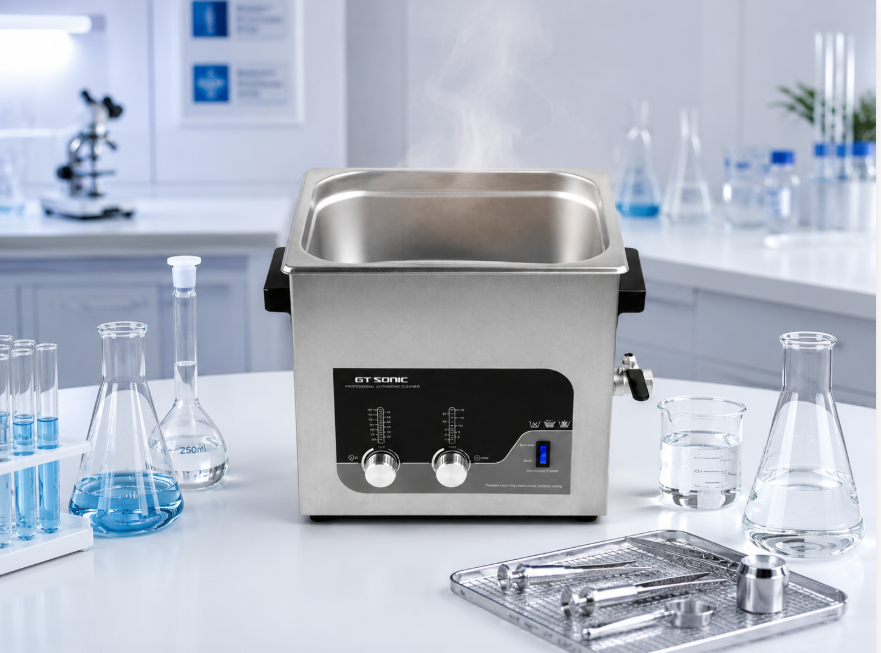
For laboratories cleaning glassware, stainless steel tools, sample containers, small instruments, and selected metal parts, a heated ultrasonic bath can improve cleaning efficiency when temperature, cleaning liquid, and material compatibility are controlled properly.
What Is a Heated Ultrasonic Cleaner Used for in Laboratory Cleaning?
A heated ultrasonic cleaner is used for laboratory cleaning tasks where warm liquid helps improve ultrasonic cleaning performance. It combines ultrasonic cavitation with controlled heating to make certain residues easier to remove.
How Does Ultrasonic Cleaner Heat Improve Cleaning?
Ultrasonic cleaner heat improves cleaning by reducing the viscosity of oils and softening certain residues. When the cleaning liquid is warm, grease and oily films may separate from glassware or metal surfaces more easily.
Heat does not replace cavitation. Instead, ultrasonic heating supports the cleaning process by making the residue more responsive to cavitation and cleaning agents.
What Is an Ultrasonic Cleaner Used in Laboratory Workflows?
An ultrasonic cleaning device is used in laboratories to clean beakers, flasks, test tubes, sample vials, stainless steel tools, small instrument parts, and precision components. A heated model is especially useful when routine cleaning involves oils, waxy films, dried residues, or repeated batches.
For more sensitive workflows, the heater should be used carefully. Some residues, especially protein-based contamination, may become harder to remove if exposed to excessive heat.
When to Use Heat on an Ultrasonic Cleaner?
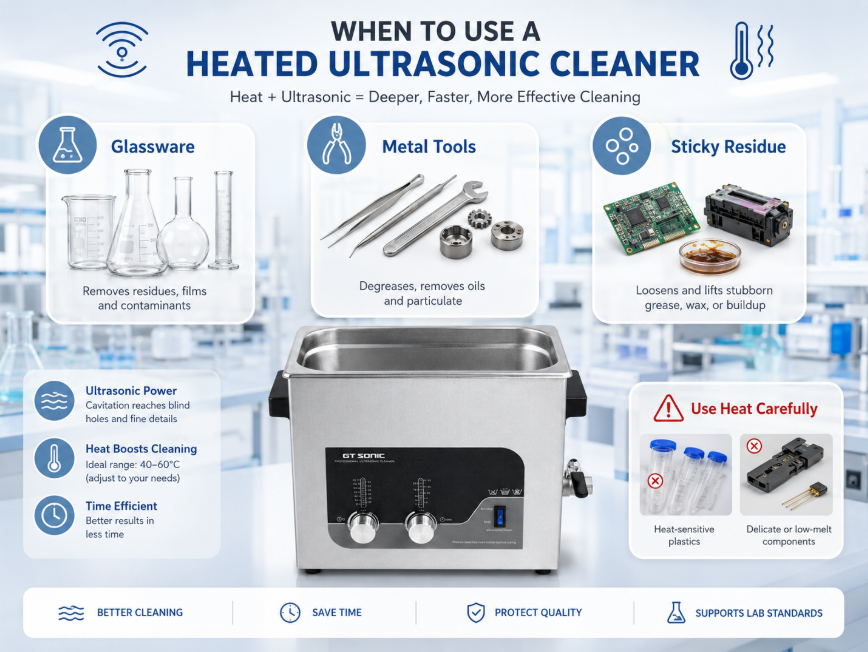
You should use heat on an ultrasonic cleaner when the residue becomes easier to remove at a controlled warm temperature. Heat is most helpful for oily, greasy, waxy, or sticky contamination.
When Does a Heated Ultrasonic Bath Make Sense?
A heated ultrasonic bath makes sense when the cleaning target is compatible with both immersion and temperature. Stainless steel tools, glassware with oily residue, and some small metal components often benefit from moderate heat.
For example, if room-temperature cleaning leaves oily films on glassware or metal tools, a warm ultrasonic bath may improve results without extending the cleaning cycle too much.
When Should You Avoid Ultrasonic Heating?
You should avoid ultrasonic heating when the item is heat-sensitive, coated, calibrated, glued, painted, or made from plastic or rubber that may deform. Heat should also be used carefully with biological or protein residues because high temperature may cause residue to set on the surface.
If the material or residue is uncertain, start with lower temperature and shorter cleaning time before increasing heat.
How Do I Choose the Right Heated Ultrasonic Tank for My Needs?
You should choose the right heated ultrasonic tank by matching tank size, heating range, timer control, ultrasonic power, basket design, and item size to your actual lab workflow. The best heated ultrasonic cleaner is the one that fits the cleaning task, not simply the one with the largest capacity.
Choose Tank Size by Glassware and Workload
Tank size should be selected based on the largest item and the normal cleaning batch size. A tank that is too small may force items to touch each other, while an oversized tank may waste liquid, energy, and bench space.
|
Lab Cleaning Need
|
Suggested Tank Choice
|
Why It Matters
|
|
Small sample vials and tools
|
Compact heated ultrasonic unit
|
Saves space and liquid
|
|
Beakers and small flasks
|
Medium laboratory ultrasonic bath
|
Supports routine lab batches
|
|
Larger tools or multiple items
|
Larger heated ultrasonic tank
|
Reduces overcrowding
|
|
Repeated daily cleaning
|
Digital heated ultrasonic cleaner
|
Improves repeatability
|
Check Heating Control and Timer Settings
Heating control and timer settings are important because lab cleaning often needs repeatable conditions. A digital heated ultrasonic cleaner allows users to set temperature and cycle time more consistently than a basic manual model.
For routine laboratory cleaning, repeatability is valuable. If different operators use the same machine, clear temperature and timer controls can reduce variation between cleaning batches.
What Temperature Is Best for a Heated Ultrasonic Bath?
The best temperature for a heated ultrasonic bath depends on the cleaning liquid, residue type, and material being cleaned. Many routine cleaning tasks use mild to moderate heat, while sensitive materials may require room-temperature cleaning.
What Temperature Works for Oils and Grease?
Moderate heating often works well for oils and grease because warmth helps reduce oil viscosity. This allows ultrasonic cavitation and cleaning liquid to remove greasy films more effectively.
However, higher temperature is not always better. Excessive heat may increase evaporation, damage materials, or reduce the effectiveness of some cleaning agents.
What Temperature Should Labs Use for Sensitive Items?
Lower temperature is safer for heat-sensitive items, coated components, plastics, rubber parts, and certain laboratory instruments. If the item has unknown compatibility, avoid high heat until the material and cleaning process are confirmed.
A practical approach is to use the lowest temperature that achieves acceptable cleaning results.
Heated Ultrasonic Cleaner vs Room-Temperature Ultrasonic Cleaning: Which Is Better?
A heated ultrasonic cleaner is better for residues that respond to warmth, while room-temperature ultrasonic cleaning is better for heat-sensitive materials or residues that may react badly to heat. The better choice depends on the cleaning task.
When Is Room-Temperature Cleaning Enough?
Room-temperature ultrasonic cleaning is often enough for light dust, loose particles,
water-soluble residue, and delicate items. In these cases, adding heat may not improve results enough to justify the risk.
Room-temperature cleaning can also be a good first test when cleaning a new material or unknown item.
When Does an Ultrasonic Cleaner with Heat Save Time?
An ultrasonic cleaner with heat can save time when the residue softens or dissolves faster at a warm temperature. Oily laboratory tools, greasy metal parts, and glassware with sticky residue may clean faster in a controlled heated cycle.
The goal is not to use the highest temperature. The goal is to use enough ultrasonic heating to improve cleaning while protecting the item.
What Features Should You Look for in a Digital Heated Ultrasonic Cleaner?
A digital heated ultrasonic cleaner should have accurate temperature control, timer settings, a stainless steel tank, basket compatibility, stable ultrasonic output, and suitable tank capacity. These features help laboratories clean more consistently.
Key Features for Laboratory Use
A good heated ultrasonic cleaning machine should be easy to operate, repeatable, and suitable for routine lab tasks.
|
Feature
|
Why It Matters
|
|
Heating function
|
Helps remove oils and sticky residues
|
|
Digital temperature control
|
Improves process repeatability
|
|
Timer setting
|
Keeps cleaning cycles consistent
|
|
Stainless steel tank
|
Supports routine lab use
|
|
Cleaning basket
|
Prevents direct contact with the tank bottom
|
|
Lid
|
Helps reduce heat loss and splashing
|
|
Drain valve on larger models
|
Makes liquid replacement easier
|
What Features Should I Look for in a Sonic GT Ultrasonic Cleaner?
When choosing a GT SONIC heated ultrasonic cleaner, buyers should check tank volume, heater control, timer type, basket size, lid design, and whether the unit fits the laboratory cleaning workload.
A suitable GT SONIC model should match the object size, cleaning frequency, and residue type rather than only focusing on price or capacity.
What Should You Look for in an Industrial Ultrasonic Cleaner for Heavy-Duty Use?
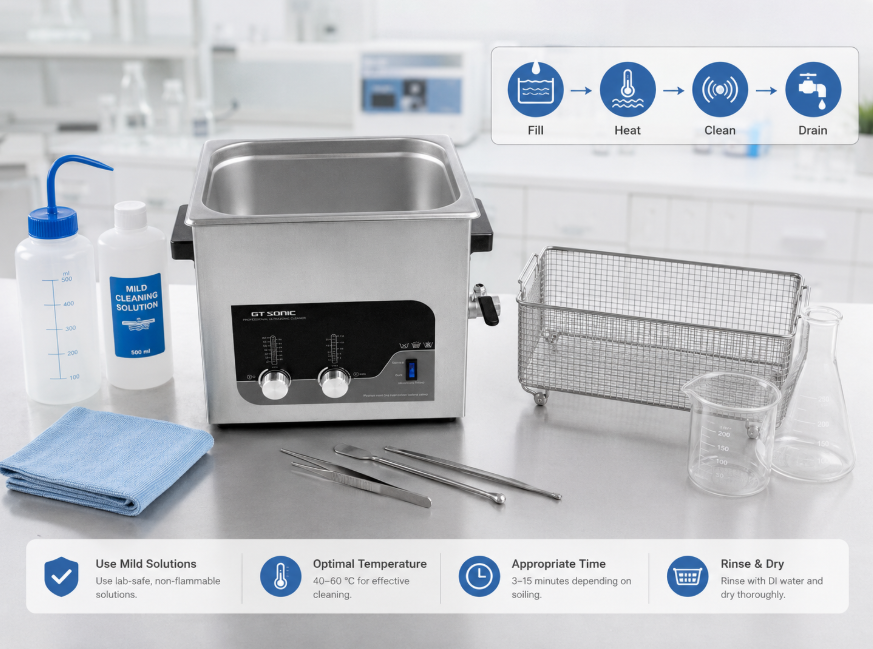
An industrial ultrasonic cleaner for heavy-duty use should provide larger tank capacity, stronger structure, stable ultrasonic output, heating control, drainage design, and compatibility with heavier parts. This matters when cleaning is no longer limited to small lab tools or glassware.
When Does a Lab Need Heavy-Duty Ultrasonic Cleaning Equipment?
A lab may need heavier-duty ultrasonic cleaning equipment when cleaning larger metal tools, production samples, mechanical parts, or repeated high-volume batches. In these cases, a small benchtop unit may not provide enough tank space or workload capacity.
Industrial-style ultrasonic cleaning equipment may also be useful for technical labs connected with manufacturing, maintenance, engineering, or quality testing.
What About Ultrasonic Heat Exchanger Cleaning?
Ultrasonic heat exchanger cleaning is a more industrial application and is different from routine laboratory glassware cleaning. It usually involves larger tanks, stronger cleaning systems, and process-specific cleaning requirements.
For a laboratory-focused article, this keyword can be mentioned as a heavy-duty application, but the main selection logic should still focus on tank size, heater control, material compatibility, and cleaning workload.
What Maintenance Is Required for Heated Ultrasonic Cleaning Tanks?
Heated ultrasonic cleaning tanks require regular liquid replacement, tank cleaning, basket inspection, heater care, and correct operating habits. Good maintenance helps keep cleaning performance stable and protects the ultrasonic cleaning equipment.
How Should You Maintain the Stainless Steel Tank?
The stainless steel tank should be emptied, rinsed, and wiped after use when the cleaning liquid becomes dirty. Residue buildup, chemical deposits, and particles should not be left in the tank for long periods.
Users should avoid strong acids, chlorides, unknown chemicals, and incompatible cleaning liquids that may corrode stainless steel.
How Can Labs Protect the Heater and Ultrasonic System?
Labs can protect the heater and ultrasonic system by maintaining the correct liquid level, avoiding dry operation, using compatible cleaning liquids, and not placing items directly on the tank bottom.
A basket should be used whenever possible. Direct contact between items and the tank bottom can reduce cleaning efficiency and may damage the tank over time.
Common Mistakes When Choosing a Heated Ultrasonic Cleaning Machine
The most common mistakes are choosing the wrong tank size, using too much heat, ignoring material compatibility, skipping the basket, and treating heat as a replacement for proper cleaning chemistry.
Mistake 1: Choosing by Tank Volume Only
Choosing by tank volume only can lead to poor results. A large tank is not always better if the items are small, and a compact unit may be unsuitable if the glassware does not fit properly.
Mistake 2: Using Maximum Heat for Every Cleaning Task
Using maximum heat for every cleaning task can damage materials or make some residues harder to remove. Temperature should be selected based on residue and material compatibility.
Mistake 3: Ignoring Cleaning Liquid Compatibility
Ignoring cleaning liquid compatibility can reduce cleaning performance or damage the tank, basket, and items. Heat may also change how a cleaning agent behaves, so users should follow the recommended temperature range.
FAQ About Heated Ultrasonic Cleaners for Laboratory Cleaning
1.When to Use Heat on Ultrasonic Cleaner?
Use heat when the residue becomes easier to remove at a controlled warm temperature. Oils, grease, waxy films, and sticky residues often benefit from ultrasonic heating.
2.How Do I Choose the Right Heated Ultrasonic Tank for My Needs?
Choose the heated ultrasonic tank based on item size, batch volume, temperature control, timer settings, basket design, and cleaning frequency.
3.What Is the Best Heated Ultrasonic Cleaner for Laboratory Cleaning?
The best heated ultrasonic cleaner for laboratory cleaning is one that matches the lab’s glassware size, residue type, cleaning volume, and temperature control needs.
4.What Is Ultrasonic Cleaner Used in Laboratory?
An ultrasonic cleaner is used in laboratory workflows to clean glassware, sample vials, stainless steel tools, small instruments, and parts with hard-to-reach surfaces.
5.Is a Digital Heated Ultrasonic Cleaner Better Than a Manual Model?
A digital heated ultrasonic cleaner is often better for repeatable lab cleaning because it allows more consistent temperature and timer settings.
6.What Maintenance Is Required for Ultrasonic Cleaning Tanks?
Ultrasonic cleaning tanks should be drained, rinsed, wiped, and inspected regularly. Users should also maintain the correct liquid level and avoid incompatible chemicals.
7.Can I Use Heat for All Laboratory Items?
No, heat should not be used for all laboratory items. Heat-sensitive materials, coated parts, plastics, rubber, and some protein residues may require lower temperature or room-temperature cleaning.
8.What Features Should I Look for in a GT SONIC Ultrasonic Cleaner?
Look for tank size, heating control, timer settings, stainless steel tank quality, basket compatibility, lid design, and whether the model fits your laboratory cleaning workload.
Conclusion
A heated ultrasonic cleaner is useful when controlled temperature improves cleaning performance for oils, grease, waxy films, sticky residues, and selected laboratory tools. It is not necessary for every cleaning task, but it can improve efficiency and consistency when used correctly.
For laboratory cleaning, the best choice depends on tank size, temperature control, timer accuracy, cleaning liquid compatibility, material safety, and workload. A heated ultrasonic bath should be selected according to the real cleaning process, not only by price or tank volume.
GT SONIC heated ultrasonic cleaning equipment can support routine lab workflows when users need controlled heating, stable ultrasonic cleaning, stainless steel tanks, and suitable accessories for glassware, small instruments, and laboratory parts.


