Tap water can produce excellent ultrasonic cleaning in one city and leave spots in another. The machine has not changed; the dissolved minerals, pH and treatment chemistry of the water have. Distilled or deionized water offers a more controlled starting point, but it is not automatically required for every pair of glasses.
| Water choice | Useful advantage | Main limitation | Best fit |
|---|
| Tap water | Convenient and inexpensive | Variable hardness and dissolved solids | Known soft water and routine cleaning |
| Distilled water | Very low mineral residue | Extra cost and storage | Final rinse or hard-water locations |
| Deionized water | Controlled ionic content | Quality varies with the system | Documented optical-shop processes |
| Softened water | Lower calcium and magnesium | Not the same as distilled water | Only when chemistry is understood |
Tap Water vs Distilled Water in an Ultrasonic Cleaner for Glasses
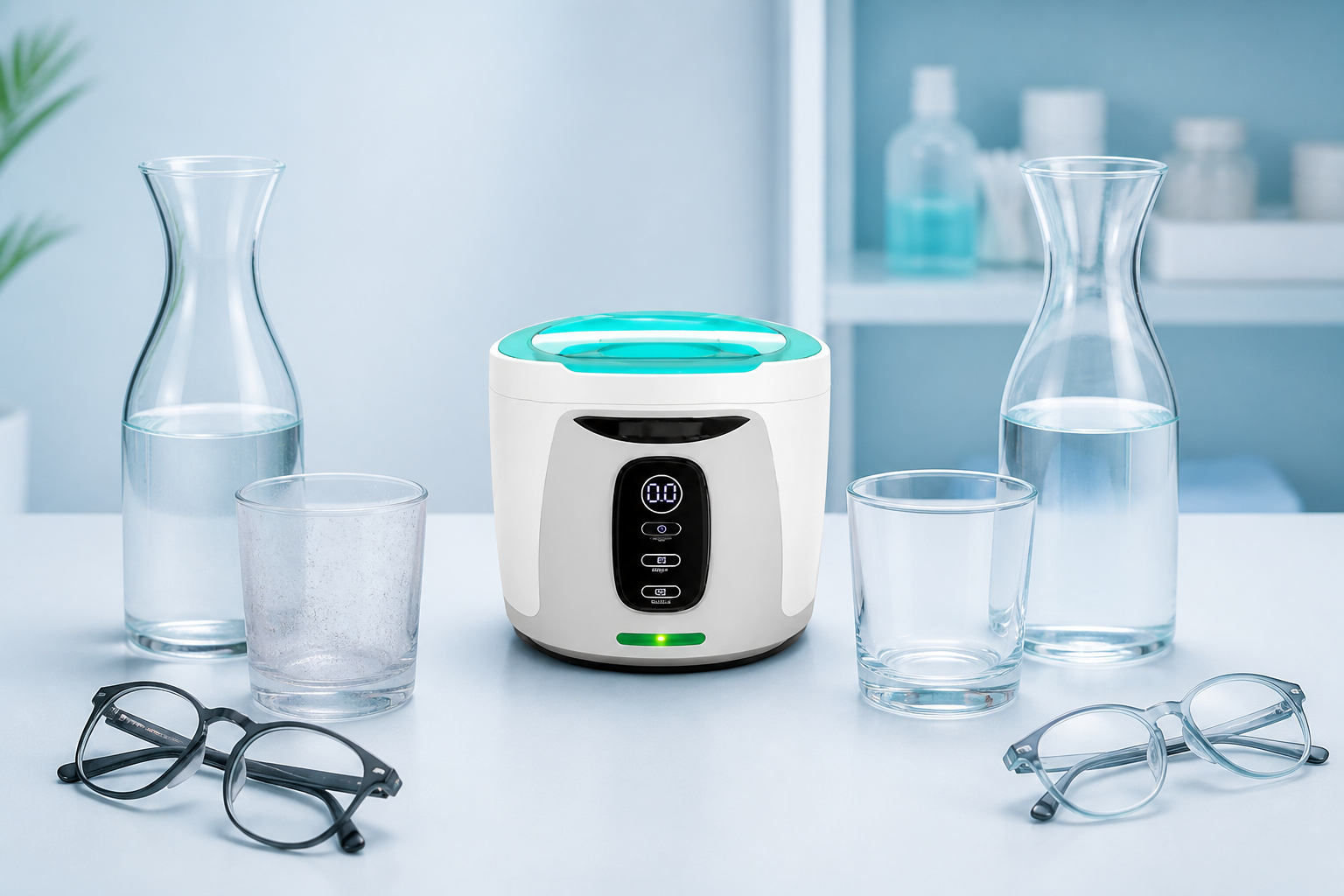
The choice affects two stages: what happens inside the bath and what remains after drying. An ultrasonic cleaner for glasses transmits acoustic energy through either type of water. Distilled water does not create ultrasound, and tap water does not stop cavitation merely because it contains minerals.
The difference becomes visible when dissolved substances interact with detergent or remain on the lens after evaporation. USGS defines water hardness mainly by dissolved calcium and magnesium. It also notes that hard water can form soap scum and leave glassware cloudy. EPA identifies total dissolved solids with effects including hardness, deposits and staining.
Therefore, tap water may be entirely practical when it is soft, visually clean and compatible with the prescribed solution. Distilled or deionized water becomes more valuable when local water repeatedly produces spots, film or inconsistent results.
How Water Hardness Changes Ultrasonic Eyeglass Cleaning
Hardness is not simply "dirty water." Calcium and magnesium are dissolved, so the water may look clear. When soap is added, those ions can form insoluble residue. When droplets dry on a lens, minerals can remain as pale spots.
USGS classifies water up to 60 mg/L as calcium carbonate as soft, 61-120 mg/L as moderately hard, 121-180 mg/L as hard and above 180 mg/L as very hard. These ranges describe water, not a universal eyeglass-cleaning limit. They are useful clues when one location gets clear lenses and another sees repeated deposits with the same machine and detergent.
Do not compensate for hard water by pouring in more detergent. Additional chemistry may create more residue and require more rinsing. First test the final rinse with low-mineral water while keeping the cycle, load and detergent dose unchanged.
When Distilled Water Helps an Ultrasonic Eyeglass Cleaner
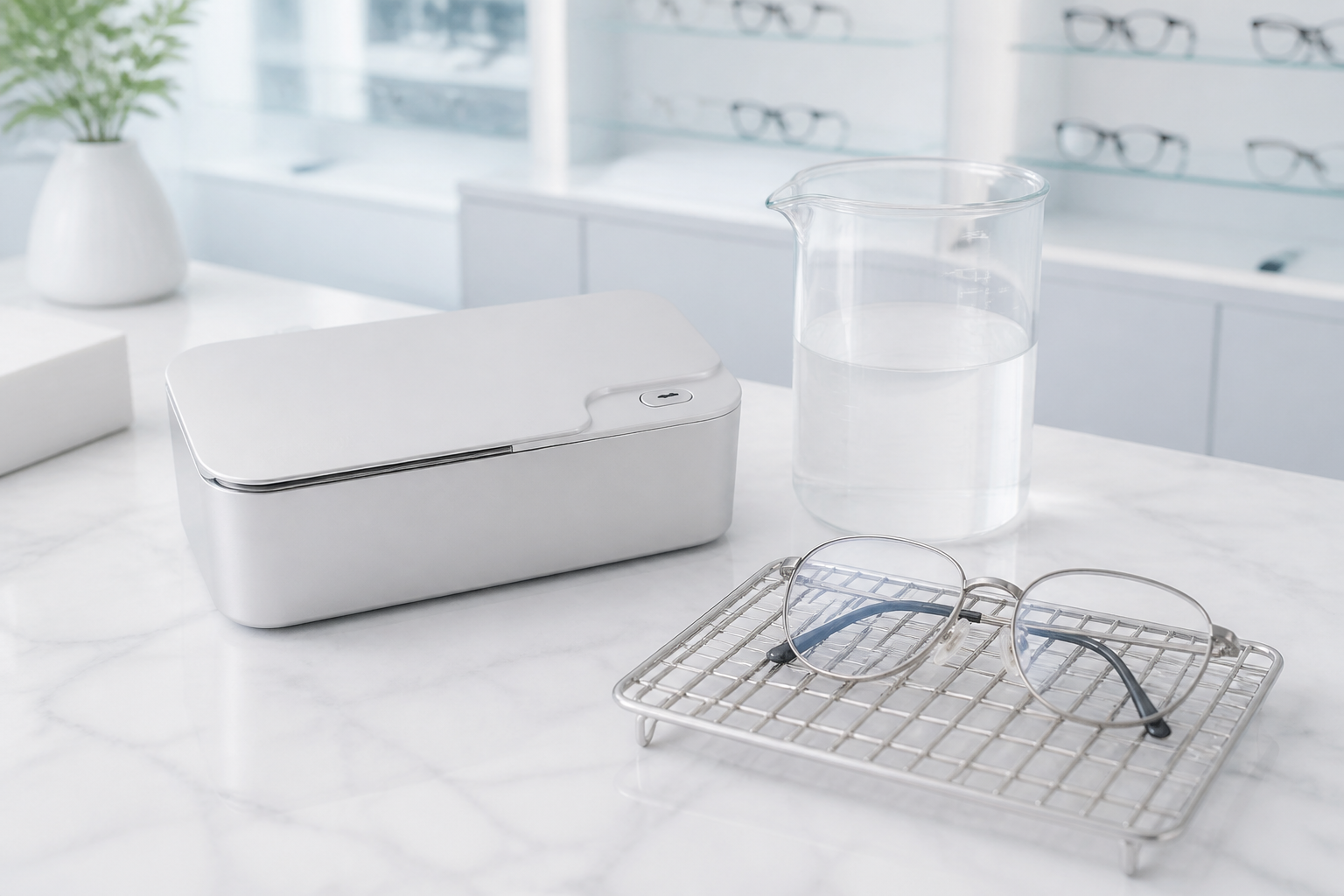
Distilled water is especially useful for the final rinse because fewer dissolved minerals are available to remain after evaporation. It can also make troubleshooting cleaner: if spots disappear when only the rinse water changes, water quality was likely part of the problem.
It may be sensible for very hard-water regions, optical shops seeking repeatability, or users drying lenses without forced air. But distilled water cannot remove a permanent scratch, repair a coating or make an incompatible frame safe for immersion.
Deionized water is another controlled option. Deionization removes charged ions, while distillation relies on evaporation and condensation. Neither label guarantees that an opened container stays clean indefinitely. Store water closed, keep pouring equipment clean and avoid returning used water to the container.
Does Low-Mineral Water Improve Cavitation?
The largest practical benefit for glasses is usually residue control, not a promise of dramatically stronger ultrasound. Cavitation also depends on dissolved gas, temperature, surface tension, frequency, power and bath loading.
A NIST-hosted ultrasonic cleaner manual explains that fresh solution contains dissolved air that reduces effective ultrasonic action and that the bath may need degassing. This applies to distilled water too. Opening a new bottle does not eliminate dissolved gas or replace the equipment's specified preparation step.
Prepare the bath consistently. Fill to the indicated level, add only approved solution, degas as directed and keep glasses in the basket rather than on the tank bottom. Water choice is one controlled variable, not a substitute for correct operation.
Build a Water Test for an Ultrasonic Spectacle Cleaner
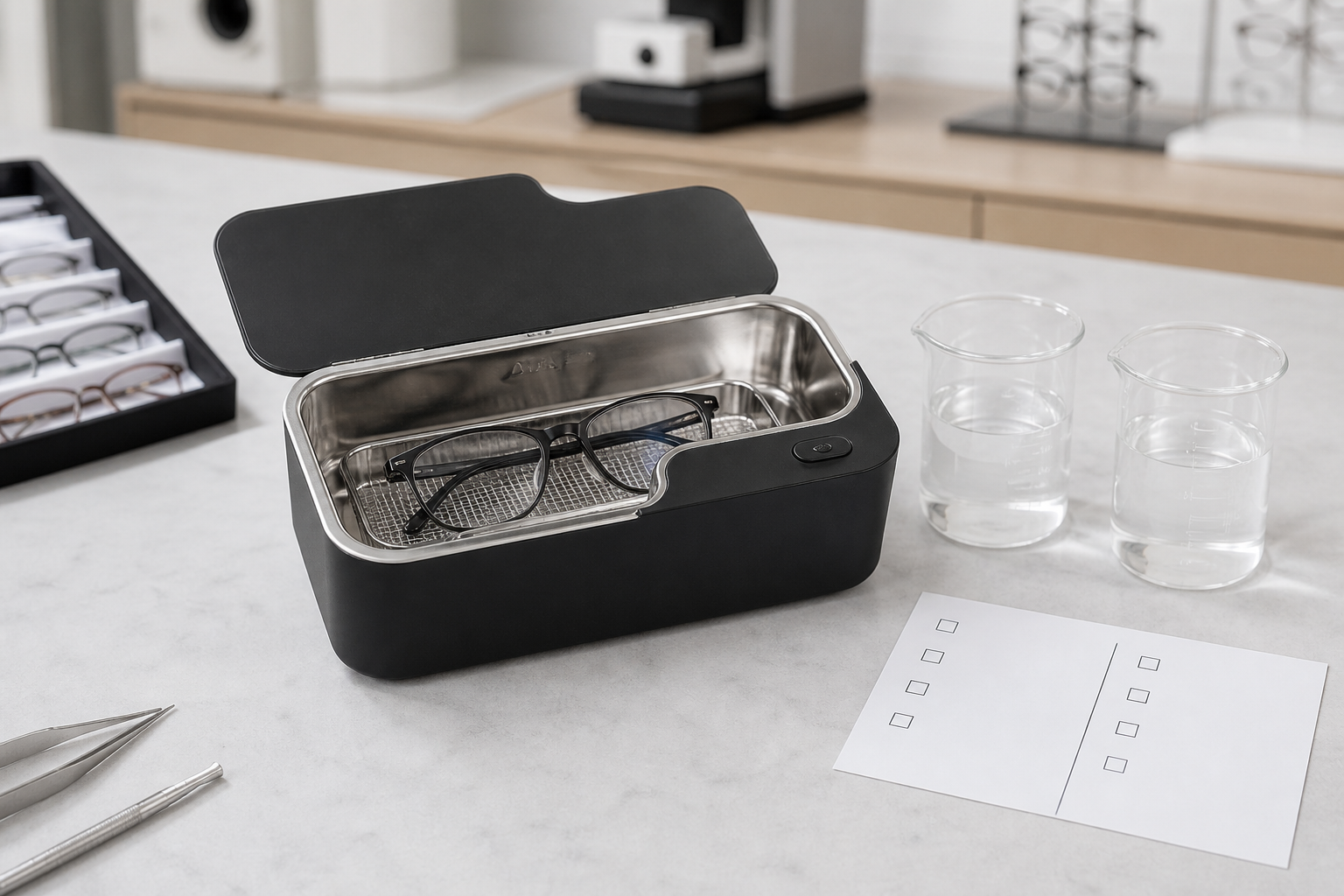
A simple two-run comparison is more useful than guessing from the water label. Use one known-compatible pair or a test lens, the same basket position, the same detergent dose and the same short cycle. Change only the rinse water first.
- Clean and rinse the tank and basket.
- Document the tap-water source and detergent amount.
- Run the approved cycle and rinse with tap water.
- Inspect after air drying under diffuse light.
- Repeat later with distilled water only in the final rinse.
- If needed, test distilled water in both bath and rinse.
If the final-rinse change removes spots, there may be no reason to use distilled water for the entire cycle. Optical shops can reduce cost while still controlling the stage that determines the visible finish.
Choose Water Without Damaging Eyeglass Coatings
Water purity does not make aggressive chemistry safe. Follow the eyewear maker's limits for coatings, adhesives, frame materials and temperature. Avoid unapproved solvents and household glass cleaners.
After cleaning, rinse away loosened soil and detergent, then dry with a clean microfiber lens cloth. The U.S. Department of Veterans Affairs recommends cool-water rinsing or eyeglass solution and a microfiber cloth to reduce scratching risk.
If lenses still dry with a film after changing the rinse water, follow our step-by-step guide to troubleshooting cloudy or streaky glasses after ultrasonic cleaning. It shows how to test detergent residue, drying-cloth contamination and coating damage without repeating unnecessary cycles.
When a freshly filled bath cleans unevenly even though the rinse is clear, read why ultrasonic cleaning solution should be degassed before loading glasses. This helps distinguish a dissolved-air problem from a water-hardness problem. The GT-F3 smart ultrasonic eyeglass cleaner provides controllable operation, while water and solution choices should be validated for the eyewear being handled.
FAQs About Water for an Ultrasonic Glasses Cleaner
Can I use tap water alone?
Yes when the manual permits it and local water does not cause deposits, but a compatible wetting or cleaning agent may be needed for oily soil.
Is bottled drinking water the same as distilled water?
No. Drinking water may contain added or naturally occurring minerals. Check the label rather than assuming it is low-residue.
Should I heat distilled water?
Only if both the machine and eyewear instructions allow it. Lens coatings, adhesives and plastic frames can be heat-sensitive.
How often should the bath be replaced?
Replace it when contaminated or as specified by the process. Low-mineral water still collects oil, particles and detergent during use.
Standardize Your GT SONIC Water and Rinse Process
Send GT SONIC your local water condition, frame range, daily load and visible finish requirements. Contact our team to match tank capacity, cycle control and bath preparation to a repeatable eyeglass-cleaning process.
Authoritative references
U.S. Geological Survey: Hardness of Water
U.S. EPA: Secondary Drinking Water Standards and Deposits
NIST-hosted Ultrasonic Cleaner Operator's Manual
U.S. Department of Veterans Affairs: How to Care for Your Eyeglasses


