An ultrasonic cleaner can light up and make noise while producing disappointing results. Troubleshooting should therefore separate three questions: Is the unit receiving power? Is it generating useful cavitation? Is the cleaning process correctly matched to the load?
| Symptom |
Possible cause |
Safe first check |
| No display or response |
Power, plug, adapter or fuse issue |
Verify approved power source |
| Timer starts but no normal sound |
Control or transducer fault |
Stop and consult the manual |
| Normal sound but poor cleaning |
Loading, liquid or cavitation issue |
Refresh liquid and correct placement |
| One side cleans better |
Uneven load or performance zone |
Reposition a compatible test item |
| Unit stops early |
Protection circuit or overheating |
Unplug and allow cooling |
| Water heats rapidly |
Long repeated cycles or fault |
Stop repeated operation |
| Excessive noise |
Tank contact, loose lid or mechanical issue |
Remove contact and inspect |
| Cloudy results |
Residue or contaminated liquid |
Rinse and replace solution |
| Leaking tank |
Seal or tank damage |
Disconnect immediately |
Start With Safe Ultrasonic Eyeglass Cleaner Checks
If the ultrasonic eyeglass cleaner is not working, unplug it before inspecting the cord, adapter or exterior. Do not open the housing unless you are qualified and authorized; power electronics and transducers are not user-serviceable parts on most household models.
Confirm that the outlet, voltage and adapter match the product specifications. Check whether the tank is filled to the instructed level. Never run a bath dry, and do not exceed the maximum line.
If liquid is leaking, stop immediately. Moving the unit, resealing it with household adhesive or continuing “for one more cycle” can create an electrical hazard.
When an Ultrasonic Cleaner for Glasses Runs but Does Not Clean
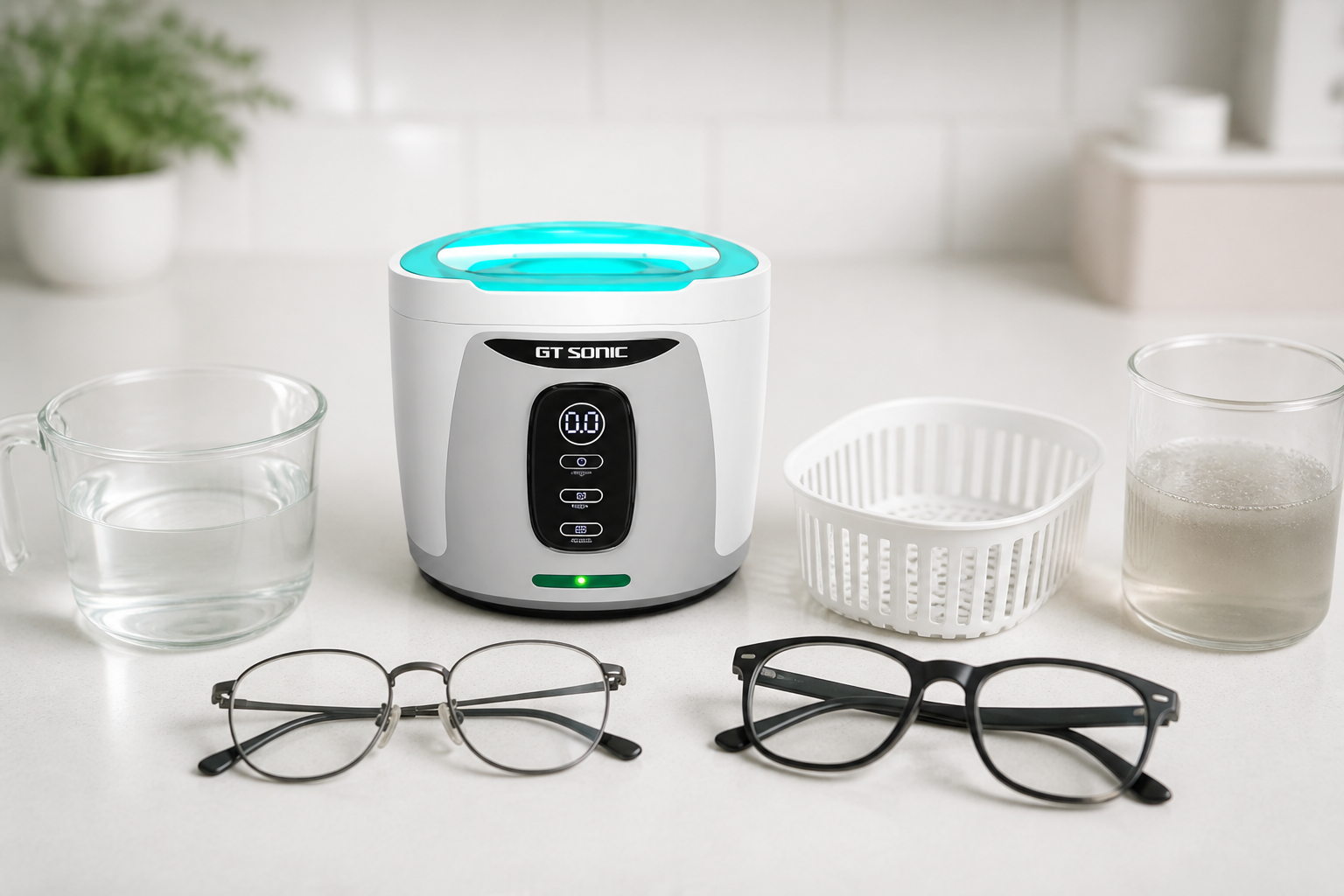
The FDA explains that ultrasonic cleaning depends on cavitation, not audible buzzing alone. Acoustic waves create bubbles that form and collapse, disrupting the bonds that hold particles to surfaces.
An ultrasonic cleaner for glasses may produce weak results if the solution is old, the liquid level is wrong, the load is stacked or the glasses touch the tank. Replace the liquid, clean the basket and place one known-compatible test item correctly.
Do not judge performance only by visible surface bubbles. PubMed-indexed research found that some products marketed to test cavitation could show passing results even when cavitation was absent. Use the test and maintenance procedure specified by the equipment maker.
Fix Uneven Ultrasonic Spectacle Cleaner Results
Uneven cleaning often begins with placement. An ultrasonic spectacle cleaner needs liquid around the item. Wide frames pressed against a wall or multiple pairs touching each other restrict access and may rattle.
Use the basket, separate items and avoid the tank bottom. If a compatible test object cleans on one side but not another, repeat with controlled placement. Persistent unevenness may require technical inspection of the transducer system.
Do not compensate indefinitely by increasing cycle time. Longer cycles can raise temperature and expose eyewear to more chemistry without correcting the underlying distribution problem.
Diagnose Eyeglass Cleaning Machine Heat and Noise
Some temperature rise is possible during operation, especially over repeated cycles. Rapid or abnormal heating, a burning smell, intermittent power or a changed mechanical sound requires shutdown.
OSHA notes that audible noise associated with ultrasonic cleaners can include subharmonics. Noise level alone is not a cavitation meter, but a sudden change from the machine’s normal sound can signal contact, a loose component or abnormal operation.
Allow the eyeglass cleaning machine to cool in a ventilated location. Remove items only when safe, disconnect power and contact the supplier with the model, serial information and symptoms.
A Nine-Step Ultrasonic Cleaner Machine Reset
- Disconnect power and inspect for leaks or visible damage.
- Confirm the correct outlet, voltage and approved adapter.
- Clean the tank and basket according to the manual.
- Add fresh approved liquid to the correct level.
- Run the specified degassing procedure if applicable.
- Load one known-compatible test item without tank contact.
- Select the standard short cycle.
- Compare the result under consistent lighting.
- Stop and request service if the defect remains.
This reset changes one variable at a time. It is more informative than repeatedly cycling valuable eyewear.
GT SONIC Ultrasonic Cleaner Troubleshooting Information to Provide
A useful service report also records what changed immediately before the fault: a different adapter, solution, basket, load size, room temperature or sequence of repeated cycles. Note whether the symptom occurs from a cold start or only after several loads. This timeline helps separate an application variable from a repeatable equipment fault and reduces unnecessary trial cycles.
When contacting GT SONIC, include the model, purchase date, power source, liquid, operating time, load and exact symptom. Photos or a short video can help document display behavior, noise or leakage without opening the housing.
For a VGT-800, note whether the three-minute automatic cycle starts and completes normally. For a GT-X1, report adapter details and whether the five-minute shutoff behaves consistently. Accurate observations shorten diagnosis.
FAQs About an Ultrasonic Eyeglass Cleaner Not Working
Can I run the cleaner empty to test the sound?
No. Operate only with the required liquid level and according to the manual.
Does more detergent restore weak cleaning?
Not necessarily. Excess detergent can leave residue. Correct liquid condition and cavitation are more important.
Can I repair a leaking tank myself?
Disconnect the unit and seek authorized guidance. Improvised repair near electrical components is unsafe.
Why does cleaning weaken after several loads?
The liquid may be contaminated, temperature may have risen or the load may differ. Refresh and standardize the process.
When is replacement better than repair?
That depends on warranty, part availability, damage and service assessment. Do not decide by bypassing safety controls.
Get GT SONIC Eyeglass Cleaning Machine Support
Contact GT SONIC with your model and troubleshooting record. Our support team can help confirm operating steps, warranty options and whether the unit requires authorized service.
Authoritative references
FDA ultrasonic cleaning mechanism
PubMed cavitation-test research
OSHA ultrasonic-source guidance


