A microfiber cloth and an ultrasonic cleaner solve different cleaning problems. One gives the wearer immediate control over a visible smudge. The other sends cleaning action through a liquid, reaching joints and recesses that cannot be wiped easily.
Asking which method is “better” without defining the contamination leads to an unhelpful answer. The safer method is the one that removes the soil with the least unnecessary stress on the particular lenses and frame.
| Cleaning need |
Microfiber cloth |
Ultrasonic cleaner |
| Single fingerprint |
Fast and practical after loose dust is removed |
Usually unnecessary |
| Loose surface dust |
Do not dry-wipe; rinse first |
Can remove dust, but full immersion may be excessive |
| Oil inside hinges |
Limited access |
Strong advantage |
| Dirt around nose-pad mounts |
Difficult to reach completely |
Strong advantage |
| Unknown or damaged coating |
Stop and seek advice |
Stop and seek advice |
| Several compatible frames in a shop |
Labor-intensive |
Can improve workflow if items are separated |
| Immediate cleaning while traveling |
Highly portable |
Depends on access to equipment and water |
The most useful conclusion is not that one method should replace the other. A good eyeglass-care routine uses each at the right moment.
How an Ultrasonic Eyeglass Cleaner Removes Hidden Soil
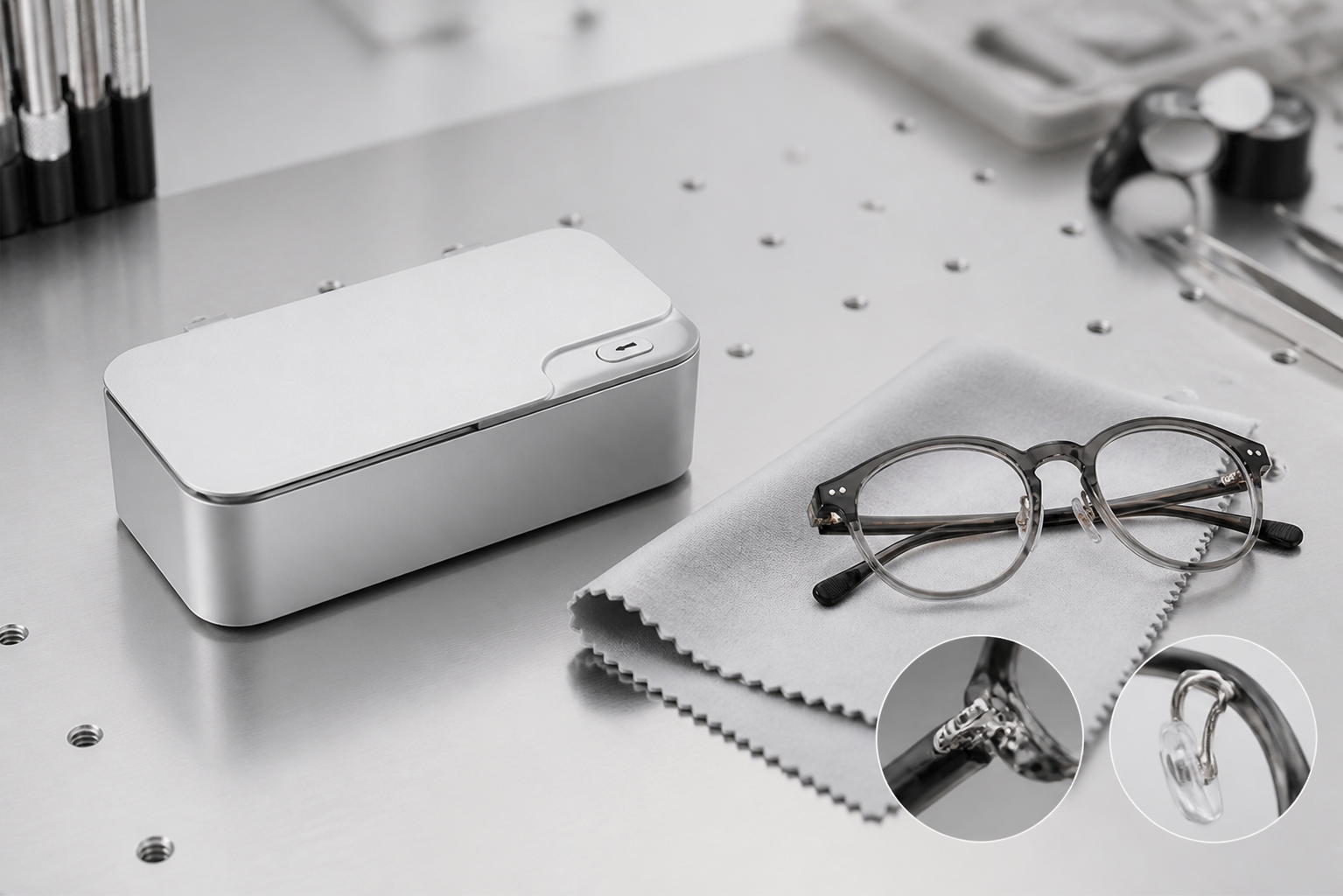
An ultrasonic eyeglass cleaner uses a transducer to transmit high-frequency vibration into the liquid. The U.S. Food and Drug Administration explains that ultrasonic energy creates cavitation—the rapid buildup and collapse of numerous microscopic bubbles. Their collapse produces a local cleaning action on the immersed surface.
For glasses, this action can travel around screws, hinges, nose-pad fittings and the edge where the lens meets the frame. A cloth cleans only where it makes contact. That difference becomes obvious when a frame looks clean from the front but still releases cloudy residue from its joints during a deep-cleaning cycle.
Ultrasonic cleaning also avoids dragging a cloth repeatedly through narrow fittings. However, it immerses the complete item. That means lens coatings, adhesives, decorations and frame finishes must all be compatible with the liquid and operating conditions.
When a Microfiber Cloth Is Best for Cleaning Eyeglasses
A clean microfiber cloth remains one of the most practical tools for everyday lens care. The U.S. Department of Veterans Affairs recommends rinsing eyeglasses with cool water or using eyeglass-cleaning solution, followed by a microfiber lens cloth to help avoid scratches.
The word “clean” is important. A soft cloth may still hold particles from previous uses and carry them across the lens under pressure.
University of Oregon optical-care guidance advises removing dust before wiping because rubbing dust into an optical surface may cause scratches. It also emphasizes gentle pressure and warns against using a dirty microfiber cloth. Although camera and eyeglass lenses are not identical products, the underlying handling principle applies to delicate optical surfaces: remove loose grit before contact cleaning.
A microfiber cloth is best when the contamination is limited to light fingerprints or a small water mark and the lens has first been rinsed or cleared of loose particles. It is also the more convenient method away from home, provided the cloth is stored cleanly.
Ultrasonic Cleaner for Glasses vs Dry Wiping
The meaningful comparison is not simply ultrasonic cleaner for glasses versus microfiber. It is ultrasonic cleaning versus the way the cloth is actually used.
Dry wiping a dusty lens with pressure creates a different risk profile from gently drying a rinsed lens with a clean cloth. Similarly, a short ultrasonic cycle in a correctly sized basket is different from several heated cycles with an unsuitable chemical cleaner.
Use manual care for accessible, light surface soil; use ultrasonic cleaning when contamination extends into inaccessible frame structures; use neither method blindly when eyewear is damaged or its construction is unknown.
Which Method Is Safer for Coated-Lens Glasses?
Neither method can be declared universally safer for every coated-lens pair of glasses.
Peer-reviewed optical-care guidance available through the U.S. National Library of Medicine describes anti-reflective coatings as thin and delicate. It recommends consulting the manufacturer, removing dust before cleaning and avoiding excessive pressure. Those precautions support a condition-based decision rather than a blanket endorsement.
For an intact coating with an approved care procedure, rinsing and gentle microfiber drying may be entirely suitable. For buildup concentrated in a compatible frame, an optical professional may decide to remove the lenses and clean the frame separately.
If the lenses show peeling, fine cracks, permanent cloudiness or edge lifting, stop. Ultrasonic cleaning cannot restore a failed coating, and more wiping will not polish it back into place. The eyewear needs assessment, not stronger cleaning.
A Two-Level Eyeglass Cleaning Machine Routine
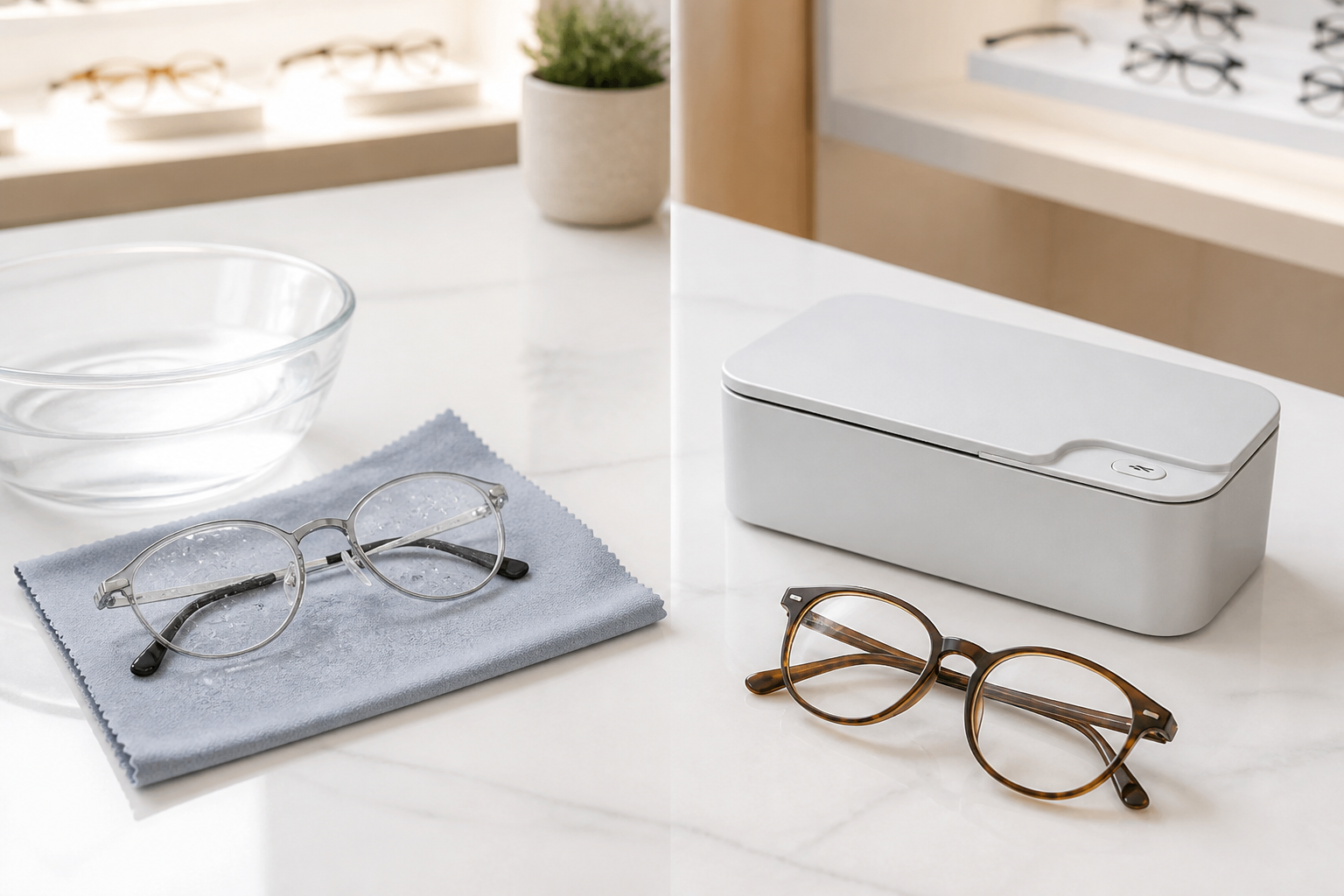
Households and optical shops can combine both methods in a simple two-level system.
Level 1: daily surface care
Rinse away loose particles with cool or lukewarm water when the lens instructions allow it. Use the recommended cleaning liquid only when necessary. Dry gently with a clean microfiber cloth reserved for optical use.
Store the cloth where it will not collect grit. Wash or replace it when contaminated. Do not use clothing, paper towels or a cloth that has been carried unprotected with keys and coins.
Level 2: periodic structural cleaning
Inspect the lenses, screws and frame materials before using an eyeglass cleaning machine. Place compatible eyewear in a suitable basket so it cannot touch the tank bottom or another frame. Use a mild approved liquid and the shortest effective cycle, then rinse and dry.
GT SONIC compact cleaners offer automatic timing for a repeatable workflow. The VGT-800 uses a 600 ml SUS304 tank, 40kHz ultrasonic frequency, 35 W ultrasonic power and three-minute automatic shutoff. The GT-X1 offers a 450 ml tank, 40kHz operation and five-minute automatic shutoff. Model selection should still begin with the frame dimensions and material compatibility rather than the timer alone.
FAQs About Ultrasonic Cleaners and Microfiber Cloths
Can a microfiber cloth scratch glasses?
The fiber is designed for delicate surfaces, but trapped grit, dry dust and excessive pressure can still contribute to scratches. Rinse loose particles away and keep the cloth clean.
Why are my glasses streaky after using a microfiber cloth?
The cloth may contain oil or detergent residue, or too much cleaning product may have been applied. Wash or replace the cloth and use less approved solution.
Should the lenses face upward in an ultrasonic basket?
The priority is to keep them supported, separated and away from direct contact with the tank. Follow the equipment and eyewear instructions for the specific holder design.
What should an optical shop use for customer frames?
Use a documented decision process: inspect, identify materials, obtain approval, select manual or ultrasonic cleaning, and verify the result. Expensive or uncertain lenses may require professional removal before frame cleaning.
Choose the Right GT SONIC Eyeglass Cleaning Solution
A microfiber cloth handles daily visible marks; an ultrasonic cleaner reaches the places the cloth misses. The strongest routine combines them intelligently rather than forcing one method into every situation.
GT SONIC supplies ultrasonic cleaning equipment for household, optical-retail and commercial use. Contact GT SONIC with your typical frame size, daily cleaning volume and target market to compare standard models or develop an OEM/ODM eyeglass-cleaning solution.
Authoritative references
U.S. FDA, ultrasonic cleaning mechanism
U.S. Department of Veterans Affairs, eyeglass care
University of Oregon, optical lens-cleaning guidance
CDC, cleaning and disinfecting
U.S. National Library of Medicine, care of optical surfaces


