The frequency printed on an ultrasonic cleaner is easy to compare, so it often becomes the first number buyers notice. One machine operates at 40kHz, another at 42kHz, and a third promotes 48kHz. It is tempting to assume that the largest number must be the safest or most advanced. Ultrasonic cleaning is not that simple.
Frequency changes the way cavitation develops in the liquid, but it does not work alone. Tank design, ultrasonic power, transducer distribution, water temperature, cleaning chemistry and cycle duration all affect what reaches the glasses. The condition of the lenses and frame matters just as much.
| Frequency range |
Practical interpretation |
Suitable buying question |
| Around 40kHz |
Common general-purpose range for compact cleaners |
Does the machine provide stable, even cleaning in a short cycle? |
| Around 42kHz |
A small numerical step above 40kHz |
Is the difference supported by the complete machine design? |
| Around 48kHz |
Higher-frequency consumer option |
Does it clean the intended contamination effectively without excessive cycle time? |
This table is deliberately not a ranking. There is no authoritative government rule stating that one of these three frequencies is universally best for every pair of eyeglasses.
How Frequency Changes an Ultrasonic Eyeglass Cleaner
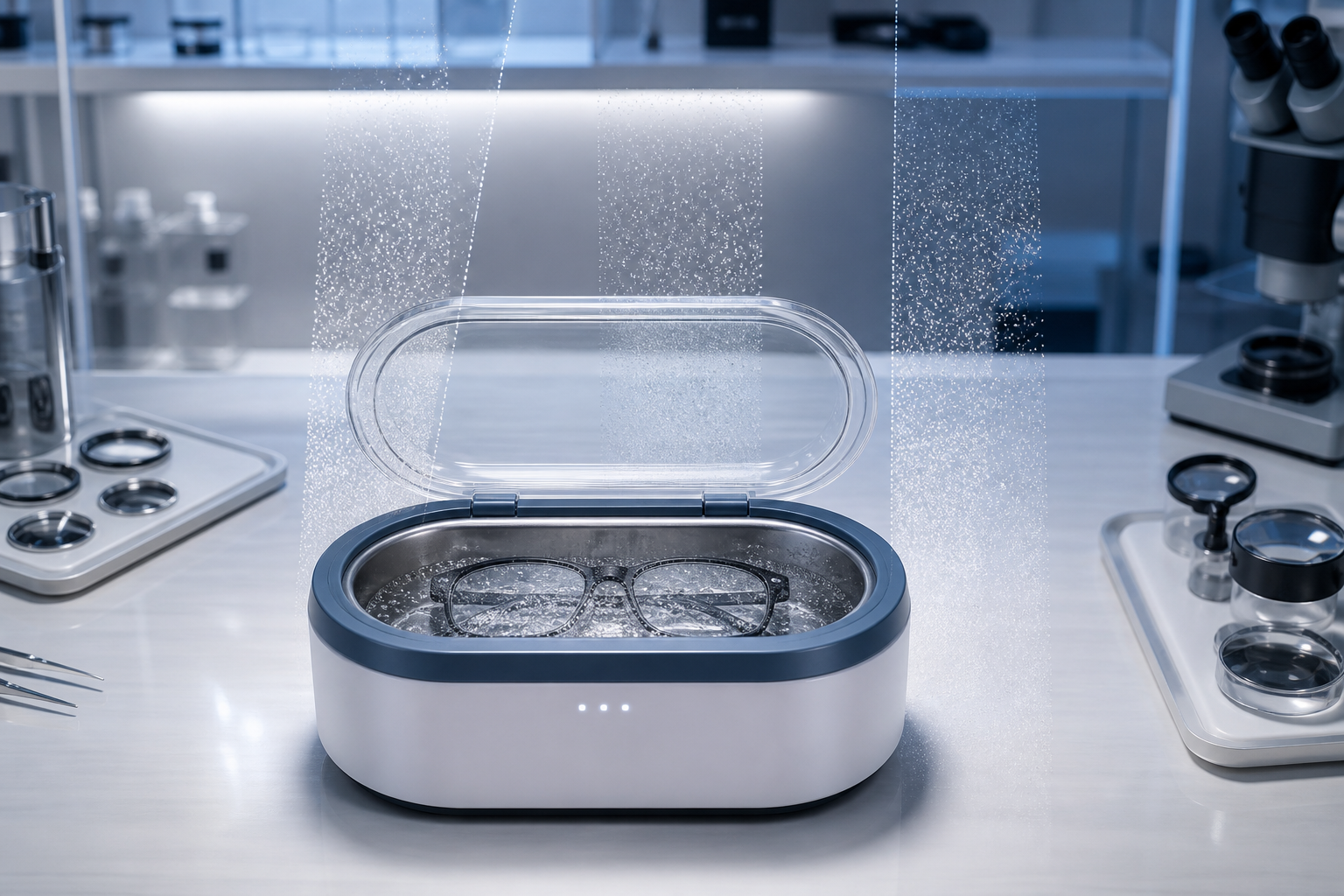
An ultrasonic eyeglass cleaner converts electrical energy into high-frequency mechanical vibration. The vibration travels through the liquid as alternating pressure waves. During lower-pressure phases, microscopic cavities form; during higher-pressure phases, they collapse.
The U.S. Food and Drug Administration describes this rapid formation and collapse of bubbles as cavitation. The resulting local forces create the cleaning action that loosens contamination from a surface. A technical explanation published by the U.S. National Institute of Standards and Technology similarly describes microscopic bubbles, pressure changes and the energy released when the cavities implode.
In broad physical terms, lower ultrasonic frequencies tend to produce larger, more energetic cavitation events, while higher frequencies tend to create smaller bubbles and a finer cleaning action. Yet eyeglass cleaning happens inside a complete acoustic system. Tank geometry can concentrate or disperse energy, the basket changes the distance between the frame and the vibrating steel, and dissolved gas affects how readily cavitation begins. Two machines with the same nominal frequency can therefore produce noticeably different cleaning patterns.
The difference between 40kHz and 42kHz is especially easy to overstate. It is only a 5% shift in nominal frequency, while differences in power density, transducer placement and cycle control may be much more meaningful. Frequency is best treated as one design parameter rather than a stand-alone quality grade.
Is 40kHz Best for an Ultrasonic Cleaner for Glasses?
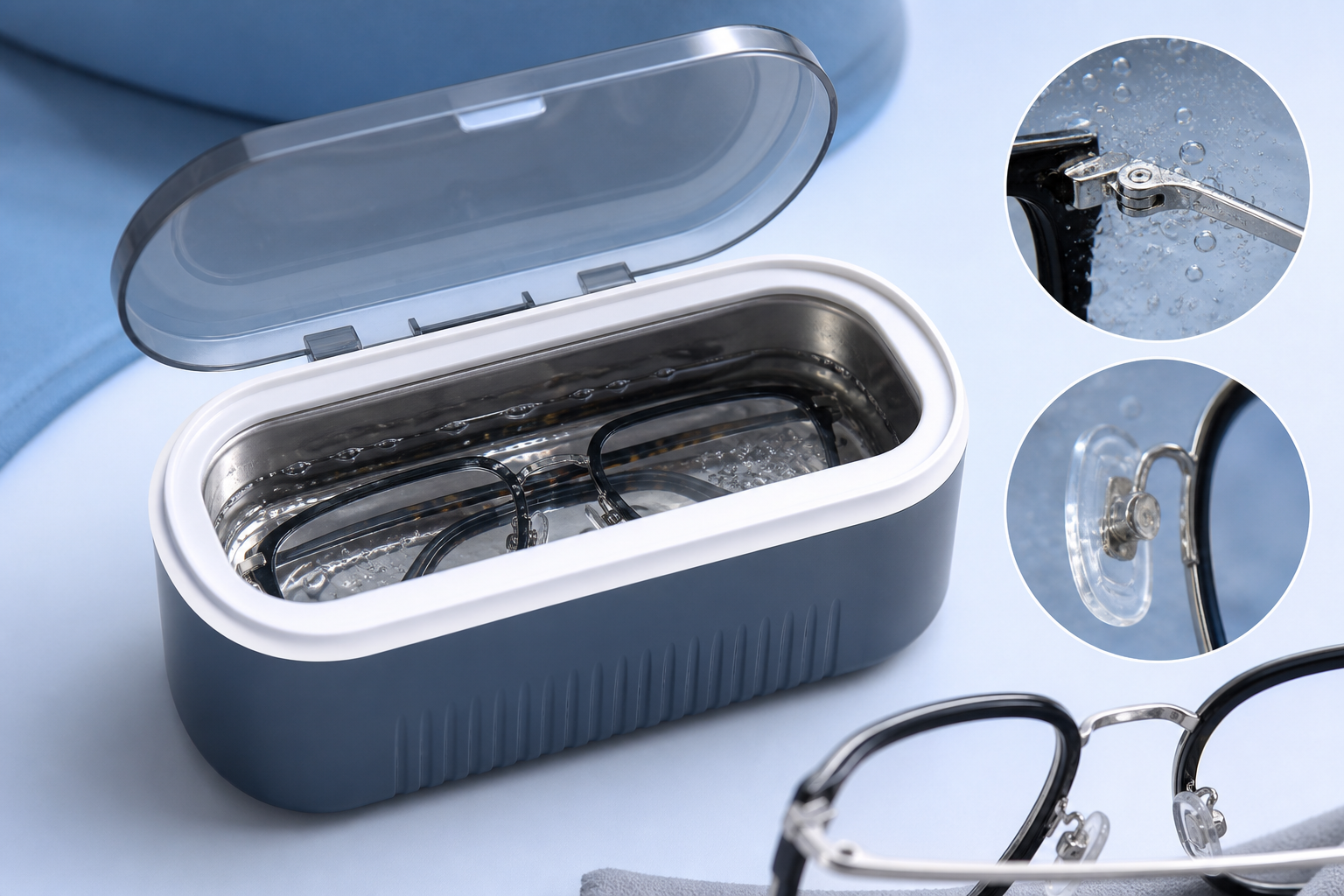
A 40kHz ultrasonic cleaner for glasses can provide a useful balance between cleaning performance and compact-machine design. It is a widely used frequency for general-purpose ultrasonic baths and can reach oil and debris around hinges, nose pads and frame joints.
The important question is whether the machine applies that energy evenly. A poorly designed tank may create strong and weak zones. Glasses placed in an ineffective area may receive limited cleaning, encouraging unnecessary extra cycles. Conversely, direct contact with the tank bottom can expose a frame to stronger mechanical vibration.
GT SONIC uses 40kHz in several compact eyewear-compatible models. Its ultrasonic glasses cleaner with automatic shutoff illustrates why frequency should be read together with capacity, power, basket dimensions and timer design. For ordinary metal frames with compatible, undamaged lenses, 40kHz may be practical. It should not be treated as automatic approval for cracked coatings, laminated sunglasses, glued decorations or unknown vintage materials.
Does 42kHz Make an Ultrasonic Spectacle Cleaner Safer?
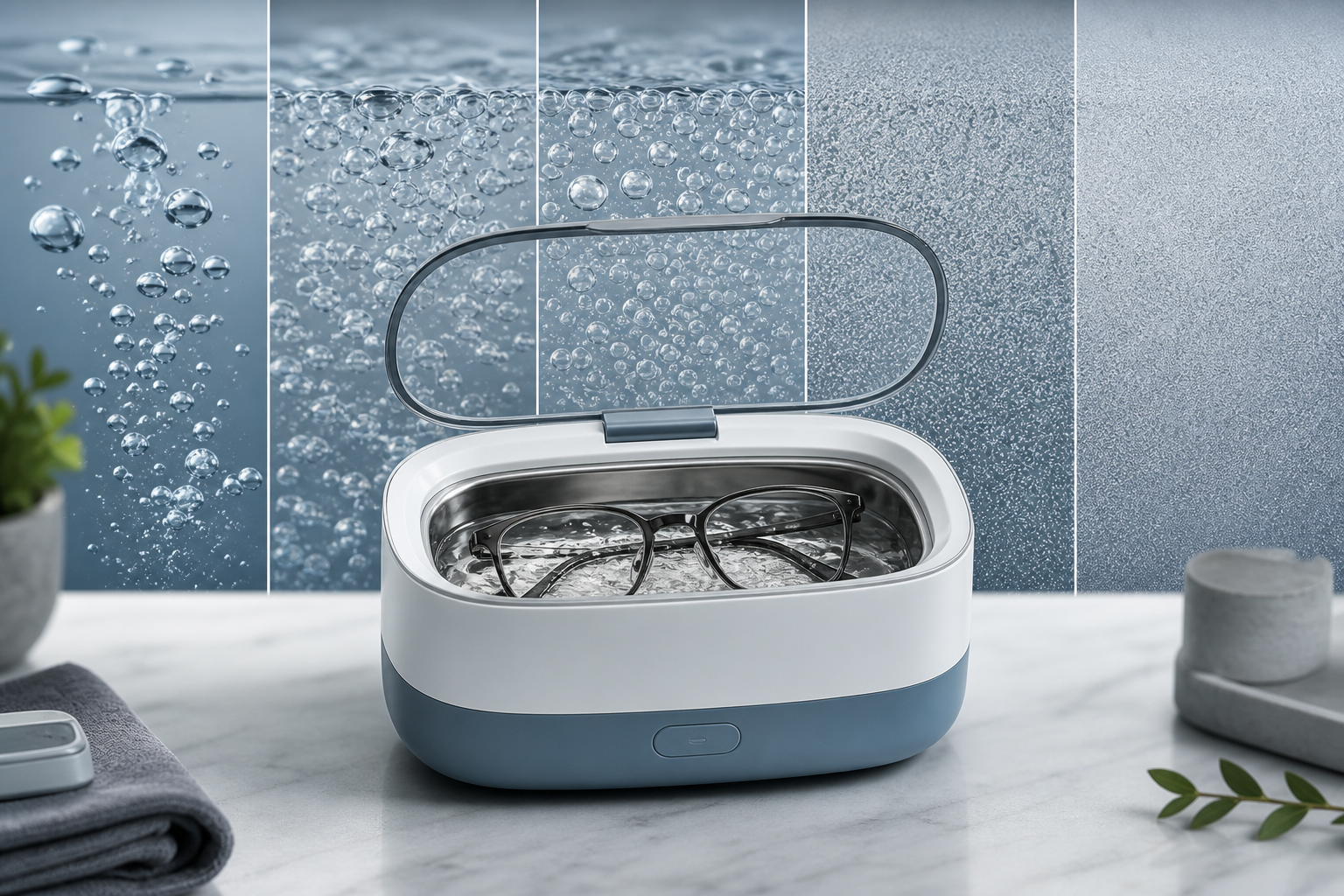
A 42kHz ultrasonic spectacle cleaner operates only five percent above 40kHz. That difference may influence bubble size and energy distribution, but the number alone cannot prove that one complete machine is gentler than another.
Consider two cleaners. The first operates at 40kHz with a short timer, moderate power and a basket that keeps the lenses away from the tank. The second operates at 42kHz but has poor energy distribution, an excessively long default cycle or no suitable holder. It would be unreasonable to declare the second machine safer based only on frequency.
For an optical shop, repeatability matters more than a small frequency difference. Test representative frames with consistent soil, water volume and placement. Record the shortest effective cycle, temperature rise and residue around hinges or nose pads. This compares complete cleaning systems rather than labels.
When a 48kHz Electronic Eyeglass Cleaner Makes Sense
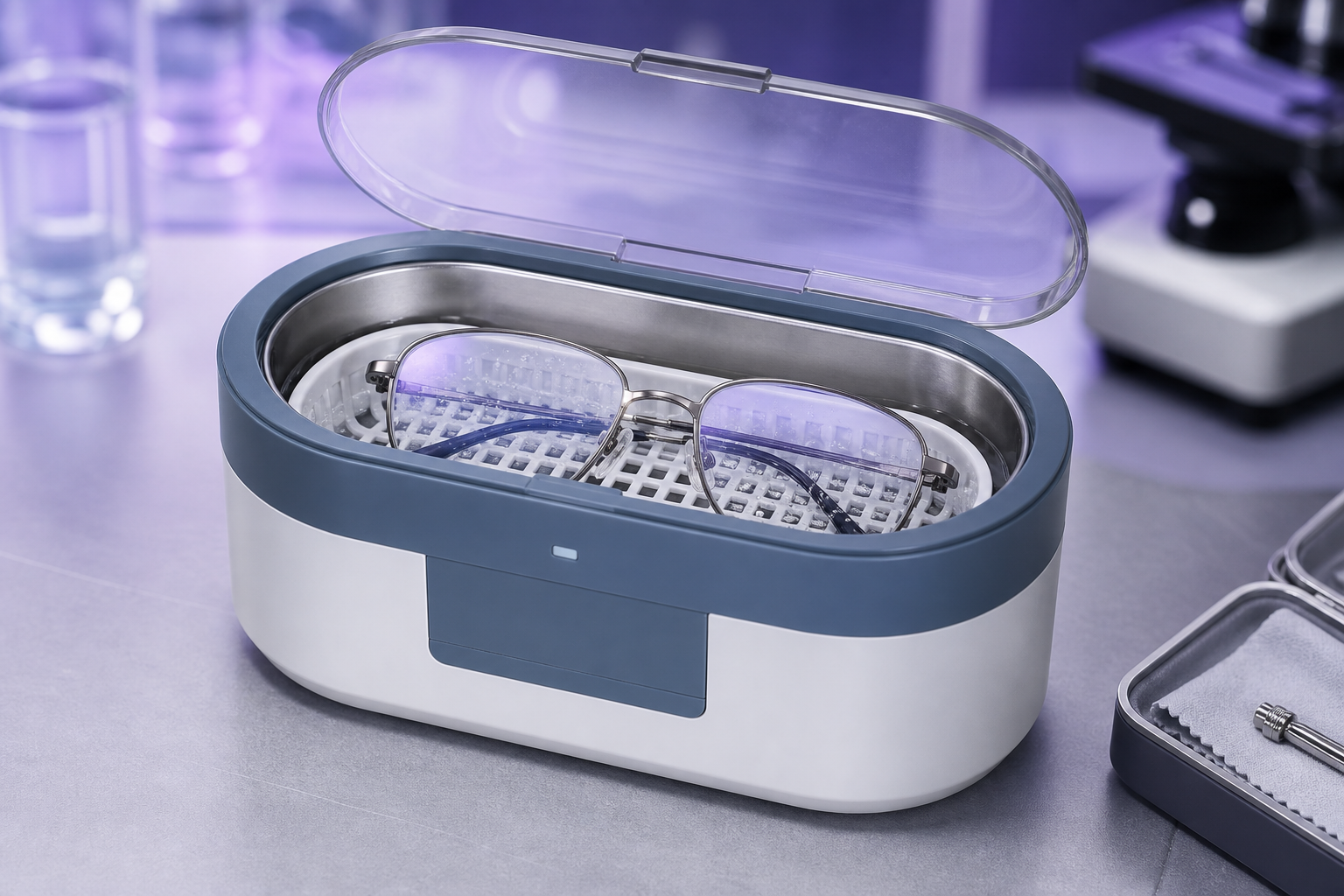
A 48kHz electronic eyeglass cleaner may appeal to users who mainly clean small, comparatively delicate objects. Higher frequency generally produces finer cavitation, but finer does not necessarily mean more effective for every type of soil.
Thick skin oil, dried cosmetics and contamination packed into nose-pad fittings may require compatible cleaning chemistry or pre-rinsing. If the user compensates for weak performance by selecting several long cycles, the theoretical advantage of a higher frequency may be reduced by longer exposure and rising water temperature. Product testing should therefore use representative eyewear and contamination, not just a frequency comparison.
Higher frequency cannot protect an already compromised coating. Inspect lenses for crazing, flaking or separation and consult the lens supplier when coating history is uncertain. Eyewear condition still determines whether ultrasonic cleaning is appropriate.
Other Specifications That Matter in an Ultrasonic Glasses Cleaner
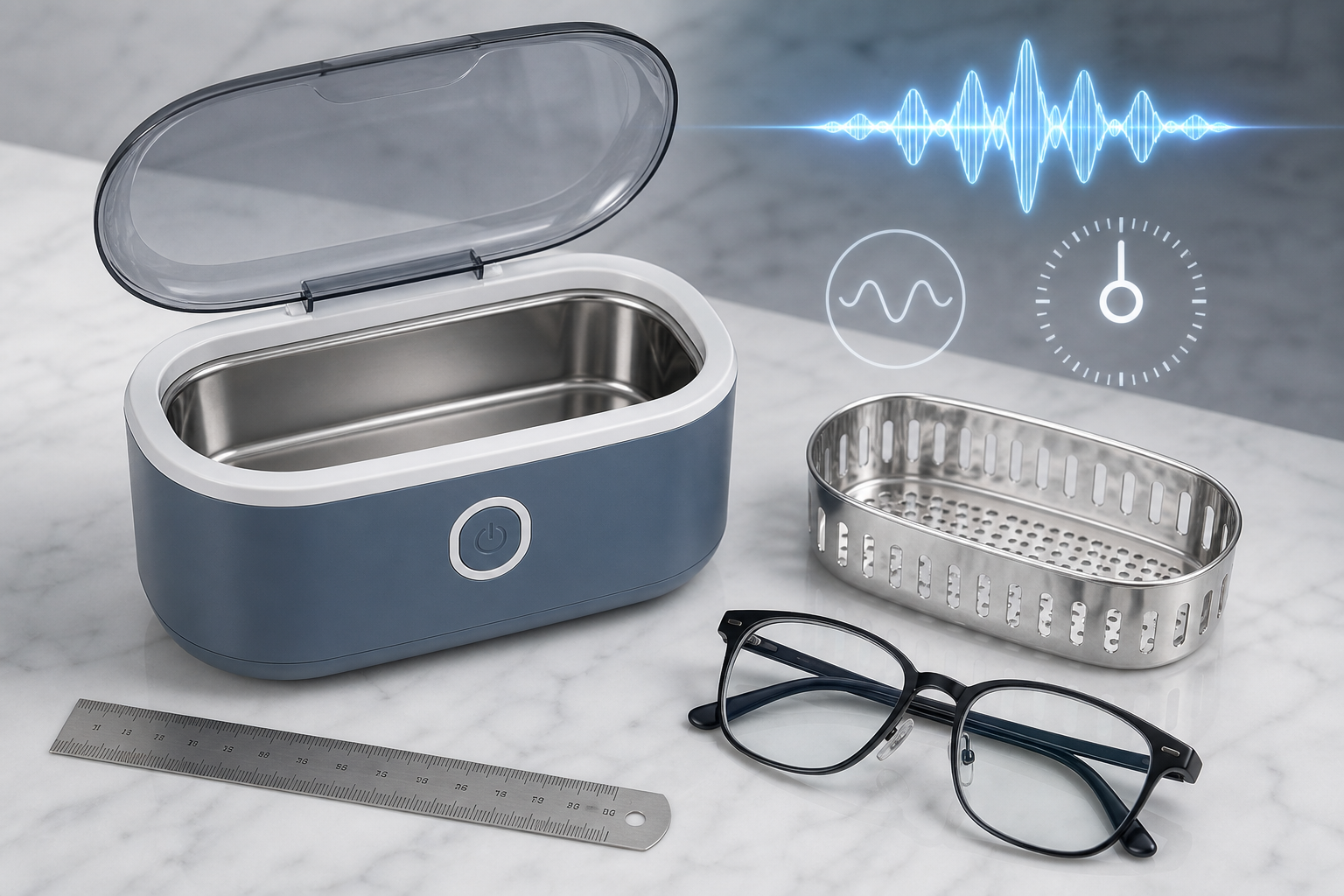
Frequency attracts attention, but several other specifications often determine whether an ultrasonic glasses cleaner is convenient and repeatable.
Power, basket and tank volume
Power must be considered with tank size, and more wattage is not an unconditional benefit. Check the usable basket measurements as well: glasses should fit without touching the sides or vibrating bottom.
Timer control
A short automatic cycle makes the process easier to repeat. It also discourages the idea that leaving glasses in the tank indefinitely will continue improving the result. If one cycle is ineffective, investigate placement, solution and contamination before simply increasing exposure.
Temperature and cleaning liquid
Repeated cycles can raise bath temperature even without a heater. During trials, keep the fill level consistent and record starting and finishing temperatures. Use a mild, material-compatible liquid, keep combustible solvents out of ordinary benchtop tanks, rinse when required and dry with clean microfiber. For more practical guidance, visit the GT SONIC ultrasonic cleaning blog.
FAQs About Ultrasonic Cleaner Frequency for Glasses
Is 48kHz always safer than 40kHz for coated lenses?
No. Frequency is only one factor. Coating condition, ultrasonic power, cycle duration, liquid temperature, chemistry and positioning also affect risk. No frequency should override the lens manufacturer's instructions.
Can I judge cleaning strength by watching bubbles in the tank?
Not reliably. Visible surface bubbles are not a precise measurement of cavitation performance. Formal testing of ultrasonic equipment uses controlled methods rather than appearance alone.
Does a higher frequency require a longer cycle?
Not necessarily. Cycle time should be determined by machine design, cleaning liquid, soil and material compatibility. Use the shortest effective validated cycle.
Which frequency should an optical-shop buyer choose?
Ask suppliers to demonstrate results using representative frames and a repeatable workflow. Compare the full system rather than purchasing from the frequency label alone.
Find the Right GT SONIC Ultrasonic Eyeglass Cleaner
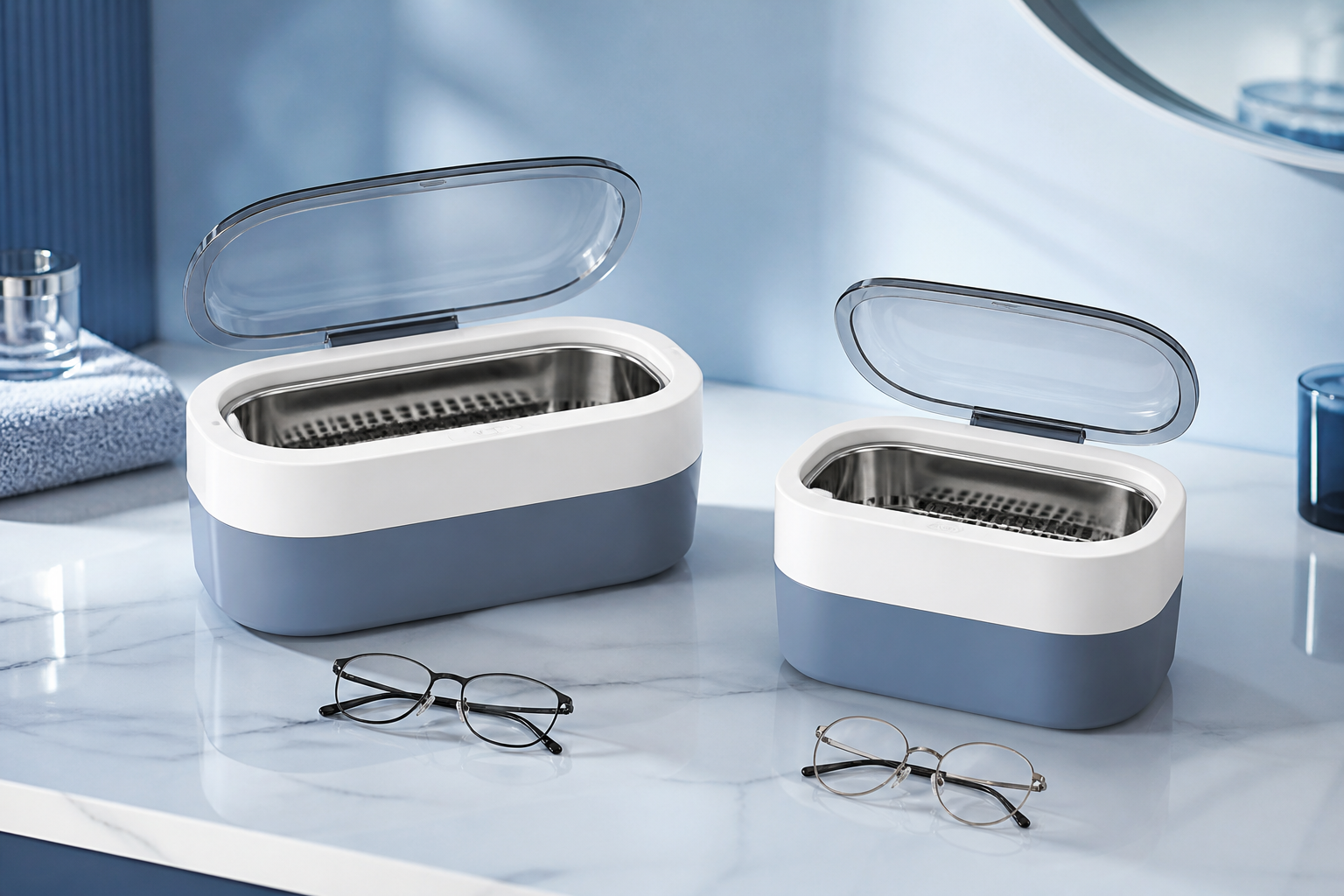
The best frequency is the one incorporated into a well-designed machine that fits the eyewear, cleaning workload and operating procedure. GT SONIC offers compact and commercial ultrasonic cleaners with different tank sizes, timers and power configurations.
Contact GT SONIC with your frame dimensions, expected daily volume and target market. Our team can help compare standard models and discuss OEM or ODM configurations without reducing the decision to a single frequency number.
Authoritative references
U.S. Food and Drug Administration — Evaluation of Production Cleaning Processes: Methods
U.S. National Institute of Standards and Technology — Sonics VC-375 Ultrasonic Processor
U.S. Occupational Safety and Health Administration — OSHA Technical Manual, Noise and Ultrasound


