The basket may look like a simple accessory, but it controls where the glasses sit, what they touch and how cleaning liquid reaches them. Poor positioning can cause rattling, blocked surfaces and avoidable contact damage.
| Loading method | Main problem | Better approach |
|---|
| Glasses directly on tank bottom | Strong vibration and metal contact | Use the approved basket or holder |
| Several frames stacked | Blocked liquid access and collisions | Separate each pair |
| Wide frame forced into a small basket | Pressure on temples or lenses | Choose a larger usable tank |
| Lens pressed against basket wire | Contact marks or uneven access | Support the frame at safe points |
| Items above the liquid line | Incomplete cleaning | Fill and load according to instructions |
Why an Ultrasonic Cleaner for Glasses Uses a Basket
An ultrasonic cleaner for glasses transmits acoustic energy through the liquid. The FDA describes cavitation as rapid formation and collapse of bubbles that produces cleaning action on immersed surfaces.
The tank bottom is part of the energy-delivery system, not a storage shelf. Direct contact can produce mechanical rattling and interfere with operation. A basket creates separation while allowing liquid to circulate.
The basket also helps control repeatability. If operators load frames differently each time, results vary and troubleshooting becomes difficult.
Position an Ultrasonic Eyeglass Cleaner Load Correctly
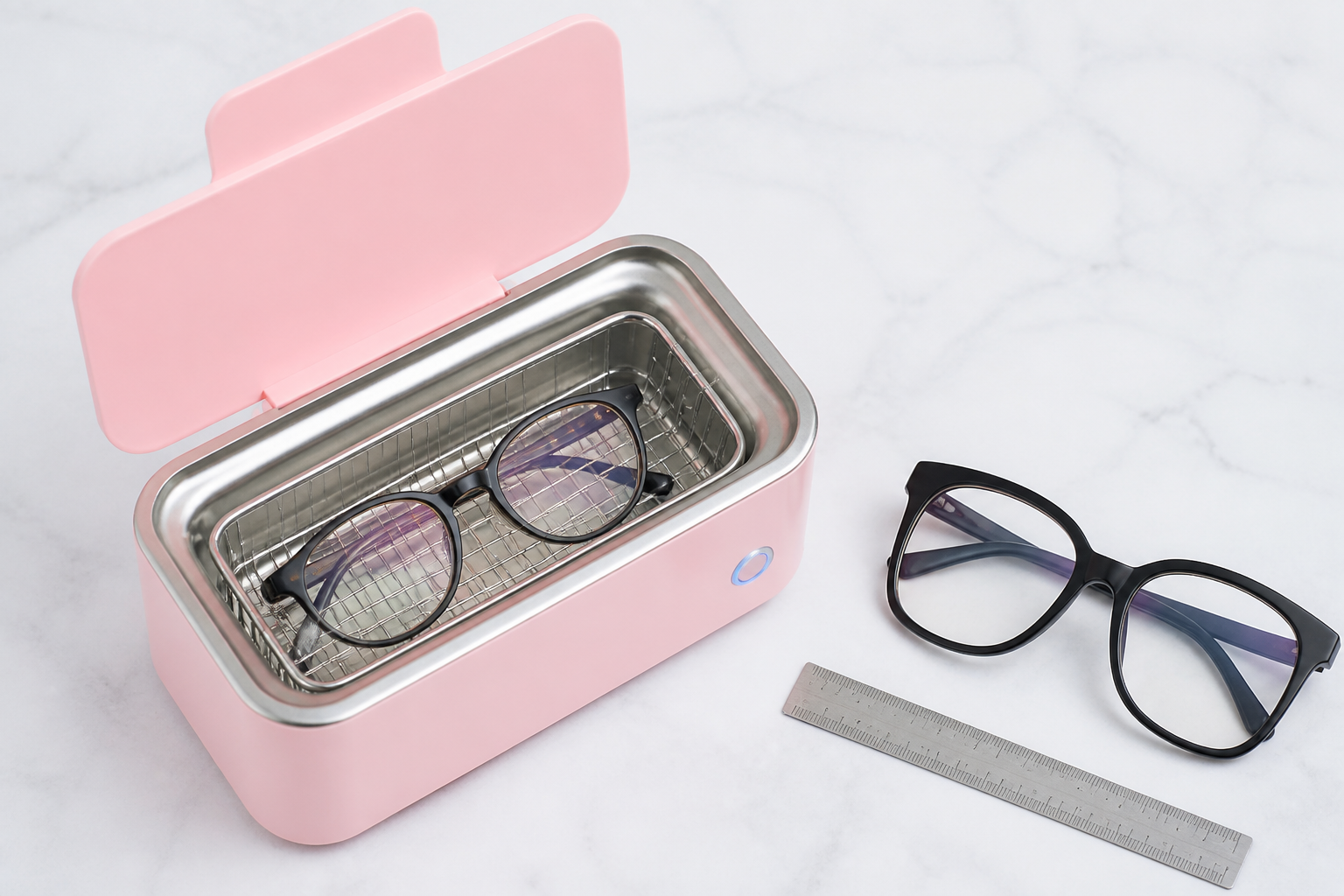
Start with one pair. Open the temples only if the frame can rest naturally without stress. Support the frame so the lenses do not press against the tank or another object.
In an ultrasonic eyeglass cleaner, every contaminated area should remain below the specified liquid level and accessible to the solution. Hinges closed tightly against another surface may trap soil. At the same time, do not force a delicate frame open beyond normal use.
Check clearance around wide sunglasses and oversized fashion frames. Tank capacity in milliliters does not guarantee usable width. Measure the basket and internal tank dimensions.
Should Lenses Face Up in an Ultrasonic Spectacle Cleaner?
There is no universal orientation for every basket and frame. Many users prefer lenses facing upward to reduce the chance of contact and allow debris to move away, but the equipment鈥檚 holder design should determine the final position.
The key requirements in an ultrasonic spectacle cleaner are support, separation and full liquid access. If 鈥渓enses up鈥?causes the temples to bear weight on a fragile joint, another approved orientation may be better.
After positioning, gently check stability before starting. The glasses should not rock into the tank wall. Stop the cycle if abnormal rattling begins.
Loading Several Pairs in an Eyeglass Cleaning Machine
Commercial users may want to process several pairs at once. More items per cycle can improve throughput only when the tank provides enough space and ultrasonic power for the load.
CDC guidance for mechanical cleaning advises avoiding stacking because contact limits access by detergent solution. Although eyeglasses are not medical instruments, the loading principle is relevant: exposed surfaces clean more consistently than nested surfaces.
Use dividers or separate holders where available. Do not allow lenses, metal temples or decorations to touch. Validate the result at the maximum planned load rather than assuming that a larger number is always efficient.
Ultrasonic Cleaner Basket Material and Cleaning Performance
A basket can slightly change the energy reaching an item, so use the accessory designed for the machine. Improvised metal racks may scratch the tank, rattle or alter loading. Soft household containers may absorb energy, float or be chemically incompatible.
Keep the basket clean. Oil, particles and detergent deposits can return to the liquid. Inspect welds and edges for damage that could catch a frame.
For a GT SONIC model, follow its supplied accessory instructions. The VGT-800鈥檚 600 ml tank accommodates common small personal items, while the GT-X1 has a compact 450 ml design. Confirm usable dimensions for the actual frame portfolio.
For an optical shop, photograph or diagram the approved loading position for common frames. A visual instruction reduces variation between employees and makes it easier to identify why a load rattled or cleaned unevenly. Update it when a new basket, frame category or maximum load is introduced.
A Five-Point Ultrasonic Glasses Loading Check
Before standardizing a load, observe one complete short cycle with a compatible frame. The eyewear should remain stable as liquid moves around it. Afterward, inspect the contact points, hinges and lens edges under good light. A repeatable position is valuable only when it protects the frame and produces consistent access to contaminated surfaces.
- The eyewear is approved for immersion and shows no visible damage.
- The basket is clean, undamaged and designed for the unit.
- Lenses and frame do not touch the tank or another item.
- Contaminated areas are submerged at the correct liquid level.
- The load remains stable without pressure on joints or coatings.
This check takes less time than repairing a scratched lens or repeating an ineffective cycle.
FAQs About Ultrasonic Cleaner Baskets
Can I use a plastic kitchen strainer?
Do not improvise unless the machine manufacturer approves it. Material and geometry can affect safety and performance.
Does the basket reduce cleaning power?
Any holder can influence energy distribution, but the approved basket balances separation and access. Use the intended accessory.
Can glasses hang from the temples?
Only with a holder designed for that position and without stressing the hinges.
What if the glasses are wider than the basket?
Choose a larger model. Forcing the frame creates contact and mechanical strain.
Should the lid stay closed?
Follow the machine instructions. A lid can reduce splashing and audible noise, but it must not press on the load.
Select a GT SONIC Ultrasonic Cleaner for Glasses
Send GT SONIC the maximum frame width, desired items per cycle and daily workload. We can recommend tank and basket options or discuss an OEM/ODM holder designed for your product range.
Authoritative references
FDA ultrasonic cleaning mechanism
CDC mechanical-cleaning loading principles
NIST-hosted ultrasonic cleaner manual


