Some glasses collect a visible film by lunchtime. Others remain clear for days. The difference may come from skin oil, cosmetics, workplace dust, cooking vapor, outdoor activity or simply how often the wearer touches the frame.
That is why there is no scientifically established rule saying every pair of glasses should enter an ultrasonic cleaner daily, weekly or monthly. A useful schedule responds to actual contamination and the condition of the eyewear.
| Wearing situation |
Sensible starting approach |
What to watch |
| Light office use |
Manual care as needed; occasional ultrasonic deep cleaning |
Fingerprints and dust around nose pads |
| Oily skin or daily cosmetics |
More frequent cleaning based on visible buildup |
Residue at hinges and lens edges |
| Kitchen, workshop or dusty work |
Pre-rinse and clean when contaminated |
Abrasive particles and heavy grease |
| Children’s eyewear |
Inspect frequently; clean when needed |
Loose screws and rough handling |
| Damaged or peeling coatings |
Do not establish a routine cycle |
Professional inspection is needed |
| Optical shop service |
Use a documented inspection-based procedure |
Cross-contamination and material compatibility |
The right question is not “How many times per week?” It is “What is on the glasses, and what is the least aggressive method that removes it safely?”
What an Ultrasonic Eyeglass Cleaner Adds to Routine Care
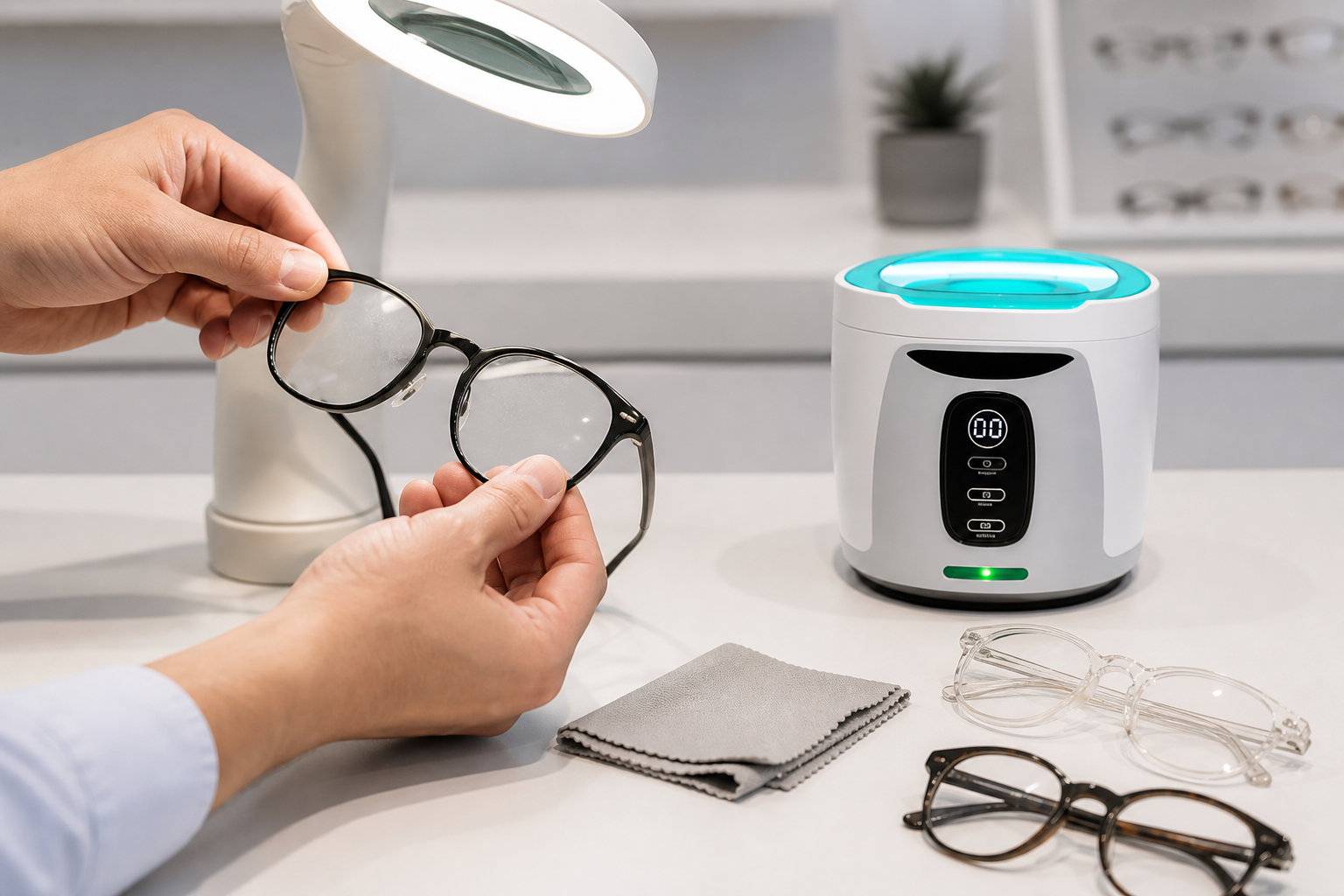
An ultrasonic eyeglass cleaner is most valuable where ordinary wiping is least effective. Cavitation acts through the liquid and reaches around nose-pad mounts, hinges, screws and the narrow line between a lens and its frame.
The U.S. FDA explains that ultrasonic energy produces the rapid formation and collapse of microscopic bubbles. This cavitation creates a scrubbing action on immersed surfaces. For eyewear, the practical benefit is access: the liquid can reach areas that a cloth cannot.
That does not mean the entire pair needs ultrasonic treatment every time a fingerprint appears. A fresh smudge on an otherwise clean lens can usually be handled with suitable manual care. The U.S. Department of Veterans Affairs advises rinsing eyeglasses with cool water or using eyeglass cleaning solution, then using a microfiber lens cloth to reduce scratching risk.
Think of ultrasonic cleaning as one tool in a maintenance system—not the only acceptable way to clean glasses.
Build an Ultrasonic Cleaner for Eyeglasses Schedule Around Soil
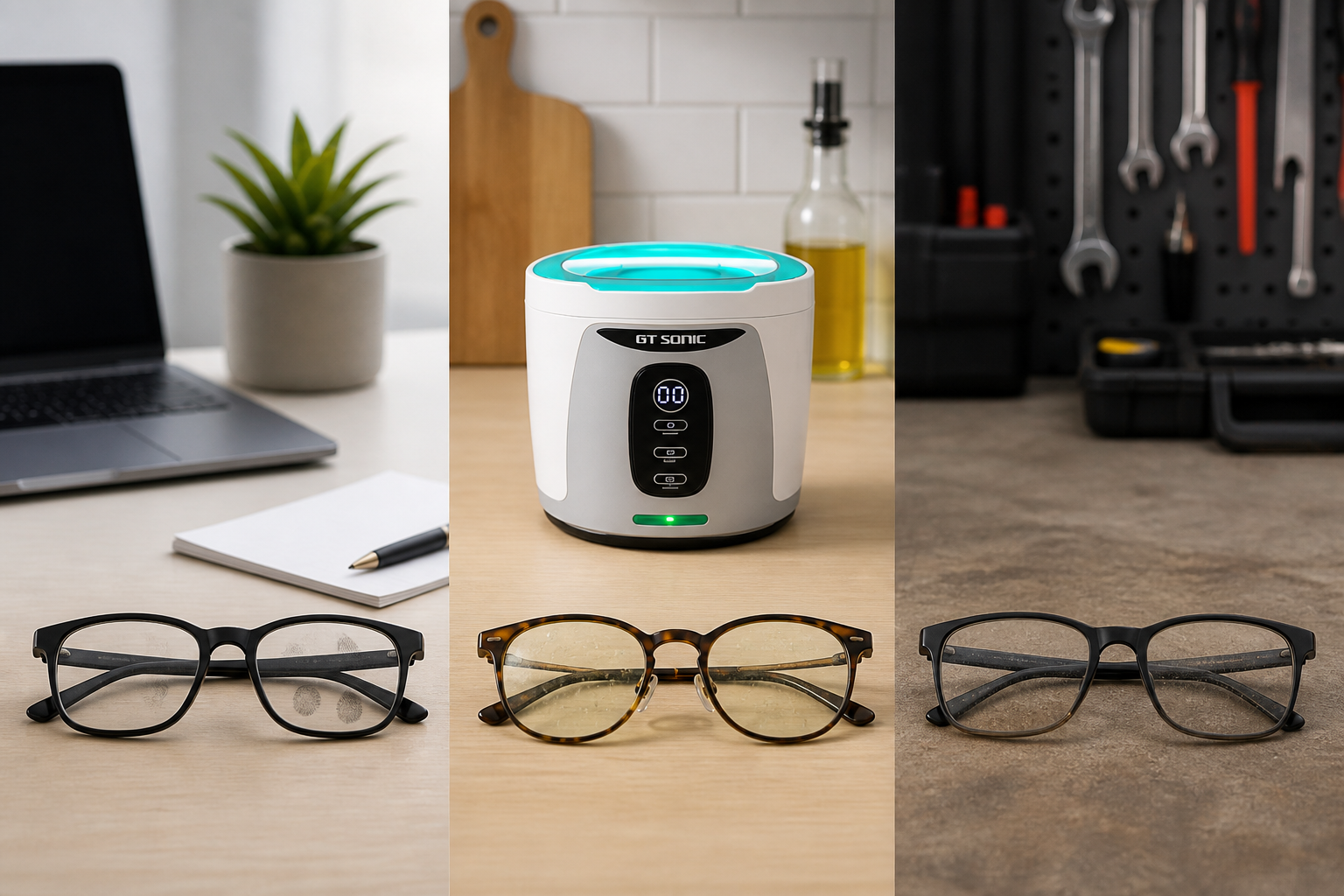
The frequency of using an ultrasonic cleaner for eyeglasses should follow the type and location of contamination.
Light surface contamination
Fingerprints and a small amount of dust usually affect the exposed lens surface. If the frame joints remain clean, careful rinsing and a clean microfiber cloth may be sufficient. There is little benefit in immersing the entire frame several times a day for one small mark.
Before wiping, remove loose particles with water. University optical-care guidance warns that rubbing dust into an optical surface can produce scratches. The cloth must also be clean.
Oil around nose pads and hinges
Skin oil, makeup and hair products migrate into recesses. This is where an ultrasonic cycle becomes useful. A weekly inspection can show whether deeper cleaning is needed, but the interval should change if the glasses remain clean or the material shows wear.
Heavy occupational contamination
Eyewear used in a workshop, kitchen or dusty environment may require prompt cleaning rather than waiting for a calendar date. Remove loose abrasive material before the ultrasonic cycle. Heavy grease may require a compatible detergent, but stronger chemistry should never be improvised merely to reduce cleaning time.
Can You Use a Home Ultrasonic Cleaner Every Day?
A home ultrasonic cleaner may be physically capable of operating every day, but that does not establish that daily immersion is appropriate for every pair of glasses.
Daily use creates repeated exposure to liquid, vibration and detergent, along with more opportunities for excessive soap, hot water or incorrect placement. A loose joint or deteriorating coating can also go unnoticed.
Unnecessary cleaning also creates unnecessary handling. Peer-reviewed optical-care guidance available through the U.S. National Library of Medicine notes that optical coatings are thin and delicate. Its useful maintenance principle is to clean when needed with the least aggressive suitable method.
Daily ultrasonic use may be reasonable only when the eyewear manufacturer permits it, the materials are compatible, the lenses are inspected and contamination genuinely requires it. It should not be presented as a universal recommendation.
Signs Your Ultrasonic Spectacle Cleaner Is Being Used Too Often
An ultrasonic spectacle cleaner does not provide a dashboard telling you that a coating is under stress. The user must look for changes before and after cleaning.
Stop and reassess the routine if lenses develop persistent cloudiness, fine cracks, edge lifting or a rainbow-like damaged area that does not rinse away. Also check whether screws are loosening, nose pads are shifting or decorative components are becoming unstable.
If the water becomes warmer over repeated cycles, allow the machine and liquid to cool. Guidance for ultrasonic equipment hosted by NIST notes that heat and cavitation can increase the chemical activity of a cleaning solution. More cycles can therefore change the operating conditions even when the control settings remain unchanged.
A Practical Eyeglass Cleaning Machine Routine
An optical shop or household can use the following decision sequence instead of a rigid timetable.
1. Inspect
Check coating condition, screws, nose pads, frame joints and decorations. Identify the contamination. Do not clean damaged or uncertain eyewear automatically.
2. Select the least aggressive method
Use careful manual cleaning for isolated lens smudges. Choose ultrasonic cleaning when residue has reached areas that are difficult to access or when a deeper clean is justified.
3. Use the shortest effective cycle
GT SONIC compact models provide automatic timing to make the process repeatable. The VGT-800, for example, has a three-minute automatic shutoff, while the GT-X1 uses a five-minute automatic shutoff. A preset timer helps avoid unattended extended immersion, but material compatibility must still be confirmed.
4. Rinse, dry and recheck
Remove loosened soil and detergent residue with clean water. Dry with a clean microfiber cloth and inspect under good light. Record unusual changes when the machine is used in a commercial workflow.
FAQs About How Often to Clean Glasses Ultrasonically
Can I run another cycle immediately if the glasses are still dirty?
First examine the reason. Incorrect placement, exhausted liquid or incompatible soil may be the problem. Repeating cycles without diagnosis adds exposure without guaranteeing a better result.
Is ultrasonic cleaning the same as disinfecting my glasses?
No. The CDC defines cleaning as removal of dirt and impurities, while disinfection requires an appropriate process that kills remaining germs. An ordinary cleaning cycle should not be advertised as validated disinfection.
Create a Better Eyeglass Cleaning Routine With GT SONIC
The best schedule is responsive, not rigid. Inspect the glasses, match the method to the soil and use ultrasonic cleaning when its ability to reach hidden areas adds real value.
GT SONIC supplies compact and commercial ultrasonic cleaners for households, optical retailers and distributors. Contact our team with your eyewear materials, workload and preferred operating routine to compare models or discuss OEM and ODM requirements.
Authoritative references
U.S. FDA, ultrasonic cleaning and cavitation
U.S. Department of Veterans Affairs, eyeglass care
U.S. National Library of Medicine, optical-surface care
CDC, cleaning and disinfecting


