Probe Sonicator vs Ultrasonic Bath for Lab Sample Preparation
Author: Zoey
Date: 2026-06-27
Read: 8min
Quick Answer
A probe sonicator delivers high-intensity ultrasonic energy directly into a single liquid sample through an immersed probe tip. It is better for tough cell lysis, nanoparticle dispersion, emulsification, homogenization, and particle size reduction.
An ultrasonic bath transfers ultrasonic energy indirectly through a water bath and sample container walls. It is better for gentle sample preparation, dissolving, degassing, cleaning, and processing multiple sealed tubes or vessels at the same time.
For most laboratories, the right choice depends on sample type, energy intensity, throughput, contamination risk, temperature control, and whether the workflow needs direct disruption or gentle ultrasonic treatment.
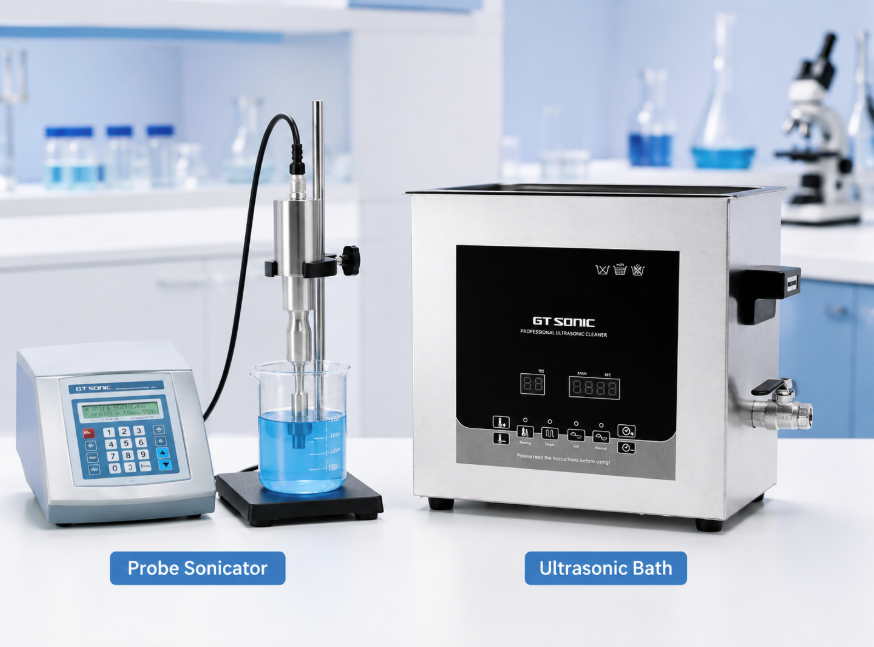
What Is a Probe Sonicator and What Is an Ultrasonic Bath?
A probe sonicator is a high-intensity ultrasonic device that uses a metal probe to deliver energy directly into a sample. The probe tip, also called a sonication probe, sonicator probe, or sonic probe, is placed into the liquid. Because the energy enters the sample directly, probe sonication creates strong cavitation and high shear forces in a small area.
This makes a probe sonicator suitable for demanding sample preparation tasks, such as breaking cell walls, dispersing nanoparticles, reducing particle size, preparing emulsions, and homogenizing single samples. However, direct contact also increases the need for probe cleaning, cooling control, and contamination prevention.
An ultrasonic bath works differently. Instead of placing a probe into the sample, the sample container is placed in a liquid-filled tank. Ultrasonic waves pass through the bath liquid and then through the vessel wall into the sample. This indirect method is gentler and more suitable for sealed tubes, vials, beakers, and multiple containers.
In laboratory use, an ultrasonic bath cleaner is often used for dissolving solids, degassing liquids, cleaning glassware, cleaning small tools, and mild sample preparation. A lab ultrasonic bath is usually easier to operate for routine workflows where high-intensity sample disruption is not required.
How Bath Sonication Differs from Probe Sonication
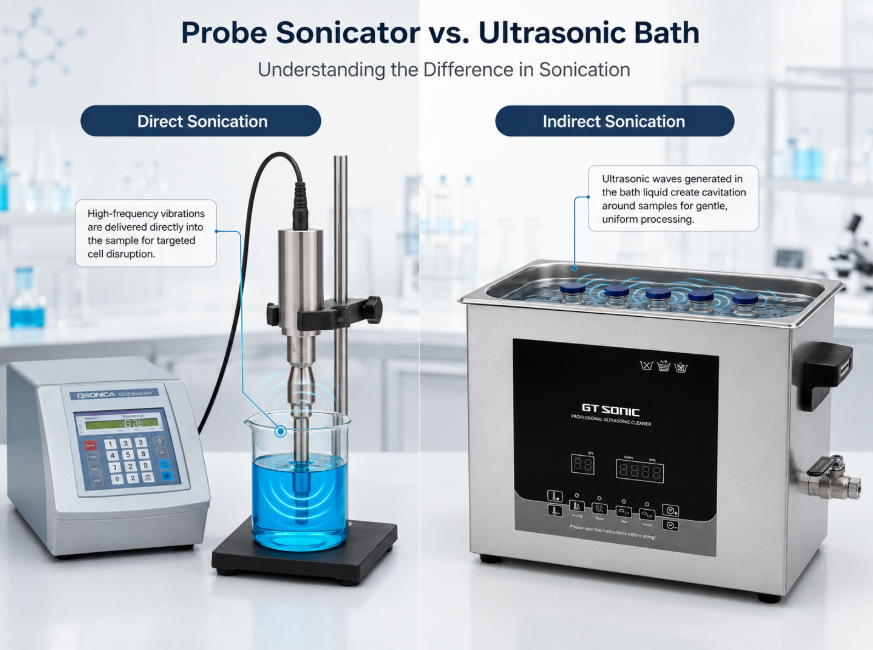
Probe sonication and bath sonication both use ultrasonic energy, but the way they transfer that energy is different.
A probe sonicator transfers energy directly from the probe tip into the sample. This creates intense cavitation near the probe and produces strong mechanical forces. It is fast and powerful, but it can also generate localized heat, foaming, and sample loss if parameters are not controlled.
A laboratory ultrasonic bath transfers energy indirectly. The ultrasonic transducers vibrate the bath liquid, and the energy passes through the water and container walls before reaching the sample. This makes the energy more diffuse and less aggressive.
If the question is “how does an ultrasonic bath work,” the simple answer is: an ultrasonic bath creates cavitation bubbles in the bath liquid, and that energy is transferred to the container, sample, or cleaning target. Compared with a probe system, an ultrasonication bath is gentler but less intense.
|
Feature
|
Probe Sonicator
|
Ultrasonic Bath
|
|
Energy transfer
|
Direct probe-to-sample contact
|
Indirect energy through bath liquid
|
|
Intensity
|
High and localized
|
Gentle and distributed
|
|
Sample throughput
|
Usually one sample at a time
|
Multiple samples at once
|
|
Best for
|
Cell lysis, emulsification, nanoparticle dispersion
|
Dissolving, degassing, cleaning, mild sample preparation
|
|
Contamination risk
|
Higher because the probe contacts the sample
|
Lower because samples can stay sealed
|
|
Heat generation
|
Higher localized heat
|
More distributed temperature rise
|
|
Repeatability
|
Strong when amplitude, time, and probe depth are controlled
|
Affected by vessel position, bath level, and container type
|
|
Maintenance
|
Probe cleaning and tip wear
|
Bath liquid and tank maintenance
|
The biggest difference is energy intensity. An ultrasonic probe sonicator is designed for direct and powerful sample disruption, while ultrasonic baths are designed for gentle, indirect ultrasonic treatment.
Reddit
Learn More
When to Choose a Probe Sonicator
Choose a probe sonicator when your sample needs direct, concentrated, and high-intensity ultrasonic energy. A probe system is usually better when a bath sonicator does not provide enough force.
A probe sonicator is commonly used for:
1.cell disruption and lysis
2.bacteria, yeast, or tissue processing
3.nanoparticle dispersion
4.nano-emulsification
5.particle size reduction
6.homogenization
7.DNA shearing
8.breaking difficult aggregates
For example, if the goal is to break tough cell walls or fully disperse agglomerated nanoparticles, probe sonication is usually more effective than a laboratory ultrasonic bath.
However, probe sonicators also have limitations. They usually process one sample at a time. The probe tip touches the sample directly, so cross-contamination is a concern. The sonication probe may also generate heat, causing sample temperature rise. For heat-sensitive samples, users may need pulse mode, an ice bath, short processing cycles, or external cooling.
If you are learning how to use a probe sonicator, the most important parameters are amplitude, processing time, pulse mode, sample volume, probe depth, vessel size, cooling method, and probe tip cleaning. A poorly positioned ultrasound probe sonicator may cause foaming, uneven processing, or sample overheating.
When a Laboratory Ultrasonic Bath Makes More Sense
Choose a laboratory ultrasonic bath when the sample needs gentle ultrasonic treatment, sealed processing, or multi-sample handling. Compared with a probe sonicator, a lab ultrasonic bath is less aggressive but more convenient for routine laboratory workflows.
An ultrasonic bath is commonly used for:
1.dissolving solids in solvents
2.degassing liquids
3.cleaning lab glassware
4.cleaning small instruments
5.processing multiple sealed tubes
6.mild mixing
7.removing trapped air from liquids
8.preparing samples that should not contact a probe
9.reducing contamination or aerosol risk
A degas ultrasonic bath can be useful when the lab needs to remove dissolved gases from solvents or mobile phases. A heated ultrasonic bath can help with dissolving, degassing, and gentle cleaning when temperature is suitable for the sample.
For labs that mainly need cleaning, dissolving, degassing, or multi-sample processing, an ultrasonic bath cleaner is often more practical than a probe system. It can process several tubes or vessels at once and keeps samples isolated inside their containers.
The limitation is lower energy density. Vessel walls, bath liquid level, sample position, and tank loading can affect performance. For tough cell lysis or high-force dispersion, bath sonication may not be strong enough.
Ultrasonic Bath Cleaner Solution and Temperature Control
The bath liquid is not just a medium for carrying ultrasonic waves. It also affects cavitation, heat transfer, sample stability, and cleaning performance. For cleaning applications, the ultrasonic bath cleaner solution can directly influence how well oils, particles, residues, and contaminants are removed from lab tools or glassware.
Why Bath Liquid and Cleaner Solution Matter
In a basic ultrasonicator bath, water transmits ultrasonic energy. However, plain water may not be enough for difficult residues or cleaning tasks. A suitable ultrasonic bath cleaner solution can lower surface tension, improve wetting, suspend loosened particles, and support more consistent cleaning.
For sample preparation, the bath liquid also affects thermal control. If the bath temperature rises during longer processing, heat-sensitive samples may be affected. This is why users should monitor temperature, especially during repeated cycles.
Heated Ultrasonic Bath for Sample Preparation
A heated ultrasonic bath can be useful when warmth helps dissolving, degassing, or gentle cleaning. For example, mild heating may improve the dissolving of some solids, reduce liquid viscosity, or help remove oily residues during cleaning.
However, heat is not suitable for every sample. Temperature-sensitive biological samples, volatile solvents, plastics, and some sealed containers may require lower temperature or short-cycle treatment. If the lab uses a degas ultrasonic bath or heated bath for sample preparation, the temperature should be checked regularly.
For cleaning workflows, an ultrasonic bath cleaner solution should match the residue and material. Mild detergent may work for general lab tools, while specialized formulations may be needed for oils, grease, flux, or biological residue.
How to Choose the Right Ultrasonic Method for Your Workflow
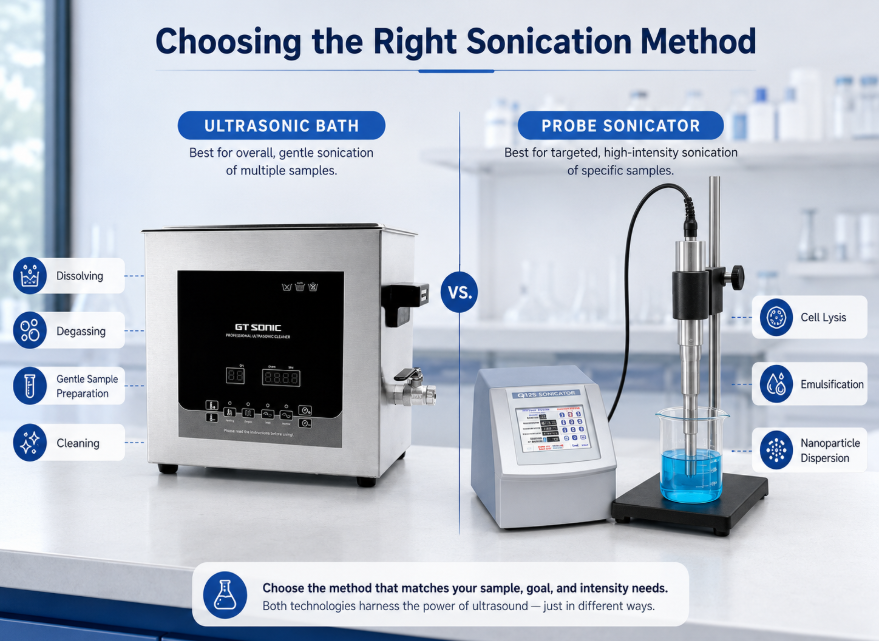
The best choice depends on what your lab is trying to achieve.
Choose a probe sonicator if the goal is high-intensity sample disruption. This includes tough cell lysis, particle size reduction, nanoparticle dispersion, and strong emulsification. It is best when energy concentration is more important than sample throughput.
Choose an ultrasonic bath if the goal is gentle, indirect treatment. This includes dissolving, degassing, cleaning, mild mixing, and processing multiple sealed samples. It is best when throughput, sample isolation, and lower contamination risk matter more.
For routine laboratory workflows, a lab ultrasonic bath is often easier to operate and maintain. For larger vessels, repeated batches, or heavier cleaning tasks, an industrial ultrasonic bath may be more suitable than a small benchtop unit.
If buyers are comparing ultrasonic bath for sale options, they should check tank size, usable basket size, heating function, degas mode, temperature control, timer settings, and whether the unit is designed for laboratory use.
Practical Selection Guide
|
Lab Goal
|
Better Choice
|
Why
|
|
Tough cell lysis
|
Probe sonicator
|
Direct high-intensity energy
|
|
Nanoparticle dispersion
|
Probe sonicator
|
Strong shear force
|
|
Emulsification
|
Probe sonicator
|
Better for fine emulsions
|
|
Homogenization
|
Ultrasonic probe sonicator
|
Strong controlled input
|
|
Dissolving solids
|
Ultrasonic bath
|
Gentle and convenient
|
|
Degassing solvent
|
Degas ultrasonic bath
|
Handles containers easily
|
|
Cleaning lab tools
|
Ultrasonic bath cleaner
|
Suitable for glassware and small parts
|
|
Multi-sample processing
|
Lab ultrasonic bath
|
Processes several tubes at once
|
|
Sealed hazardous samples
|
Ultrasonication bath
|
Lower exposure and contamination risk
|
|
Routine sample preparation
|
Laboratory ultrasonic bath
|
Easier for daily use
|
This table helps avoid a common mistake: choosing a device only by power. A stronger sonics probe sonicator is not always better. If the sample is delicate, sealed, or processed in batches, an ultrasonic bath laboratory setup may be more practical.
FAQ About Probe Sonicators and Ultrasonic Baths
1.What is ultrasonic bath used for in laboratories?
An ultrasonic bath is used for gentle sample preparation, dissolving solids, degassing liquids, cleaning glassware, cleaning small tools, and processing multiple tubes or vials at the same time.
2.How does an ultrasonic bath work?
An ultrasonic bath works by generating high-frequency sound waves in a liquid tank. These waves create cavitation bubbles in the bath liquid, and the energy transfers through the container wall to the sample or cleaning target.
3.What is ultrasonic bath compared with a probe sonicator?
An ultrasonic bath provides indirect and gentle ultrasonic energy through a liquid tank. A probe sonicator provides direct, high-intensity energy through a probe tip placed inside the sample.
4.Is a probe sonicator stronger than an ultrasonic bath?
Yes. A probe sonicator delivers direct and concentrated ultrasonic energy into the sample, so it is much stronger than an ultrasonic bath. It is better for cell lysis, dispersion, emulsification, and homogenization.
5.Can an ultrasonic bath replace a probe sonicator?
An ultrasonic bath can replace a probe sonicator only for gentle tasks such as dissolving, degassing, mild mixing, or cleaning. It usually cannot replace a probe sonicator for tough cell disruption or high-intensity nanoparticle dispersion.
6.What is the difference between a sonication probe and an ultrasonicator bath?
A sonication probe directly contacts the sample and delivers strong energy. An ultrasonicator bath transfers energy indirectly through water and container walls, making it gentler and better for sealed or multiple samples.
7.Should I choose a heated ultrasonic bath?
A heated ultrasonic bath is useful when warmth helps dissolving, degassing, or cleaning. However, heat-sensitive samples should be processed carefully with controlled temperature and shorter cycles.
8.What solution should I use in an ultrasonic bath cleaner?
For cleaning applications, the ultrasonic bath cleaner solution should match the residue and material. Mild detergents are suitable for general cleaning, while specialized solutions may be needed for oils, grease, flux, or biological residue.
Conclusion
Probe sonicators and ultrasonic baths both use ultrasonic energy, but they are designed for different lab needs. A probe sonicator is better for direct, high-intensity sample disruption, while an ultrasonic bath is better for gentle sample preparation, dissolving, degassing, cleaning, and multi-sample processing.
For laboratories handling tough cell lysis, nanoparticle dispersion, or emulsification, probe sonication is usually the stronger choice. For labs that need sealed sample handling, lower contamination risk, routine cleaning, or multiple tubes at once, a lab ultrasonic bath is often more practical.
The best decision should be based on sample type, processing goal, throughput, contamination risk, heat sensitivity, and repeatability.


