How to Choose the Right Industrial Ultrasonic Cleaner for Your Business
Author: GT SONIC
Date: 2026-10-15
Read: 11 min
What Is an Industrial Ultrasonic Cleaner and How Does It Work?
An industrial ultrasonic cleaner uses high-frequency sound waves to remove contaminants from submerged components. These waves create microscopic bubbles in the cleaning liquid that rapidly form and collapse through a process called ultrasonic cavitation, helping loosen grease, oil, machining residues, and other deposits from component surfaces.
Because the cleaning action takes place throughout the liquid, it can reach threads, recesses, and complex internal features that are difficult to clean manually. Its effectiveness depends on proper liquid contact, suitable cleaning chemistry, and operating conditions, making it a practical cleaning method for automotive parts, machined components, and other industrial applications.
Industrial Ultrasonic Cleaner vs. Traditional Parts Washer
Traditional parts washers typically rely on spray pressure, liquid circulation, immersion, or manual agitation. Ultrasonic cleaning uses cavitation to assist contaminant removal.
Neither method is universally better. The appropriate choice depends on part geometry, contamination, production requirements, and the necessary cleaning standard.
| Comparison Factor | Industrial Ultrasonic Cleaner | Traditional Parts Washer |
|---|
| Cleaning mechanism | Ultrasonic cavitation in a liquid | Spray, immersion, circulation, or mechanical action |
| Complex geometries | Useful for wetted recesses and internal features | Depends on spray access and circulation |
| Heavy surface contamination | Depends on frequency, power, chemistry, and process | Spray systems may be effective for accessible heavy deposits |
| Precision components | Suitable when materials and process conditions are compatible | Depends on cleaning pressure and handling |
| Production capacity | Determined by tank loading and cycle design | Determined by washer design and processing method |
| Maintenance | Tank, solution, transducers, and optional filtration | Pumps, nozzles, filters, and cleaning solution |
For components with complex internal features, an ultrasonic parts washer may offer advantages over conventional spray cleaning. For large components requiring rapid removal of loose surface contamination, a spray washer may be more appropriate.
Some industrial cleaning processes combine both methods to achieve the required results.
Key Factors to Consider When Choosing an Industrial Ultrasonic Cleaner
Selecting an industrial ultrasonic cleaner requires a clear understanding of the parts being processed and the demands of the cleaning operation. Workpiece dimensions, materials, contamination levels, and production volume provide the basis for evaluating tank capacity, ultrasonic performance, and equipment features.
1. Tank Size and Cleaning Capacity
The nominal tank capacity indicates how much liquid a cleaner can hold, but it does not represent the usable space available for parts. Internal tank dimensions are particularly important when cleaning large or irregularly shaped components. The workpieces must fit within the cleaning basket and remain properly immersed, with enough clearance to allow the cleaning solution to reach exposed surfaces. Overcrowding or stacking parts can leave contact areas insufficiently cleaned.
Capacity should also be considered in relation to production demand. A 105L tank, for instance, may hold several components per cycle, depending on their dimensions and arrangement. The actual output depends on how many parts can be processed together and how long the complete cleaning process takes, including loading, washing, rinsing, and unloading. Comparing these factors with daily production targets provides a more useful basis for selecting tank size than volume alone.
2. Ultrasonic Frequency and Cleaning Performance
Ultrasonic frequency influences cavitation behavior and the type of cleaning action produced in the tank. At 28kHz, cavitation generally creates larger bubbles with more forceful collapse, which can be effective for removing heavy grease, oils, and stubborn residues from robust metal components. 40kHz produces smaller cavitation bubbles and is commonly selected for general industrial cleaning, particularly when a less aggressive action is desirable.
Neither frequency is universally better. Surface condition, material sensitivity, and the nature of the contamination should guide the choice. Parts with delicate coatings or finely finished surfaces may require preliminary testing to establish suitable cleaning conditions. GT SONIC industrial cleaners are available with 28kHz or 40kHz frequency configurations, providing options for different applications.
3. Ultrasonic Power and Watt Density
Ultrasonic power is another important specification, although rated wattage alone cannot fully describe cleaning performance. Watt density, expressed in watts per liter (W/L), relates the machine's rated ultrasonic power to its nominal tank capacity. For example, a 53L cleaner rated at 900W has a nominal power density of approximately 17W/L, which can serve as a starting point when comparing machines of different sizes.
Actual cleaning performance also depends on how ultrasonic energy is distributed throughout the tank. Transducer placement, generator design, liquid depth, and workpiece loading all affect the sound field and cavitation activity. A higher power rating does not necessarily produce better results, especially when cleaning sensitive components. For applications with strict cleanliness requirements, representative parts should be tested under the intended operating conditions before a final equipment choice is made.
4. Heating, Filtration, and Additional Functions
Additional equipment features can improve process control and support routine industrial cleaning. Heating can make certain oils and greases easier to remove and enhance the performance of compatible detergents, provided the temperature is appropriate for the materials and cleaning chemistry. Adjustable timers and ultrasonic power settings help operators maintain repeatable cycles, while sweep frequency varies the operating frequency to reduce persistent standing-wave patterns and promote more even ultrasonic energy distribution.
For operations that generate substantial oil or particulate contamination, filtration and oil separation can help manage solution quality and reduce the buildup of residues in the tank. Drainage systems simplify liquid replacement, while separate rinsing and drying stages may be necessary when parts must meet specific cleanliness or downstream processing requirements. These capabilities should be evaluated according to the intended workflow rather than treated as standard features of every industrial ultrasonic cleaner.
Industrial Ultrasonic Cleaner Applications Across Different Industries
From automotive workshops to precision manufacturing facilities, industrial ultrasonic cleaning is used to handle components with different shapes, materials, and contamination levels. While the same cleaning principle applies, the equipment and process requirements can vary considerably between applications.
| Industrial Application | Typical Contaminants | Key Cleaning Considerations |
|---|
| Automotive Parts | Engine oil, grease, carbon deposits | Accommodating bulky or irregularly shaped parts and removing stubborn deposits from accessible internal passages |
| CNC Machined Parts | Cutting fluids, metal particles, machining residues | Removing debris from holes, grooves, and machined features while preventing residue from remaining after rinsing |
| Bearings and Mechanical Components | Lubricants, grease, fine particles | Reaching internal clearances and ensuring thorough drying to reduce the risk of corrosion |
| Molds and Metal Tools | Processing oils, polishing compounds, accumulated deposits | Removing buildup without affecting precision surfaces, coatings, or critical dimensions |
| Precision Metal Components | Fine particles, light oils, surface residues | Maintaining controlled cleaning conditions and meeting specified cleanliness requirements |
The choice of equipment ultimately depends on the workpiece and the expected cleaning result. Large automotive components may call for greater loading space and more intensive cleaning, whereas precision parts often demand tighter process control and careful handling. Understanding these differences helps manufacturers select equipment suited to their production tasks.
Common Mistakes to Avoid When Buying an Industrial Ultrasonic Cleaner
Even with detailed equipment specifications, selecting the wrong industrial ultrasonic cleaner can lead to cleaning inconsistencies, unnecessary operating costs, or production delays. Several common purchasing oversights are worth considering before making a decision.
1. Choosing a Tank Based Only on Capacity
A tank's advertised volume may look sufficient on paper, yet its internal dimensions could limit how parts are positioned or loaded. This becomes particularly important for bulky components, irregular shapes, or multiple workpieces cleaned together. Confirming the usable space and basket dimensions helps avoid equipment that cannot accommodate the intended workload.
2. Assuming Higher Ultrasonic Power Means Better Cleaning
More ultrasonic power does not automatically translate into more effective cleaning. While heavily contaminated components may require stronger cleaning action, sensitive surfaces can be affected by overly aggressive settings. Rather than comparing wattage alone, consider whether the machine provides suitable power control and consistent cleaning under the intended operating conditions.
Frequency selection is just as important as power. To compare how 28kHz and 40kHz configurations affect different workpieces, see our breakdown of 28kHz vs 40kHz ultrasonic cleaners and which frequency fits your parts.
3. Overlooking Cleaning Solutions and Post-Cleaning Steps
The cleaning process does not necessarily end when the ultrasonic cycle finishes. Detergent residues, inadequate rinsing, or moisture left on metal surfaces may affect subsequent assembly, coating, or storage. Cleaning chemistry, rinsing, and drying should therefore be considered together, particularly when finished parts must meet specific cleanliness requirements.
4. Focusing Only on the Initial Purchase Price
The lowest quotation may not offer the best long-term value. Frequent solution changes, additional operator handling, maintenance, and limited batch capacity can increase the actual cost of cleaning. A more meaningful comparison accounts for the equipment's expected service requirements, operating expenses, and achievable production output.
5. Skipping Cleaning Tests Before Purchase
A machine that meets the required specifications may still perform differently when loaded with actual production parts. Complex geometries, stubborn deposits, and differences in surface finishes can affect the outcome. Whenever practical, testing representative workpieces before purchase provides a clearer basis for evaluating cleaning quality, cycle time, and suitability for routine operation.
How to Match GT SONIC Industrial Ultrasonic Cleaners to Your Cleaning Needs
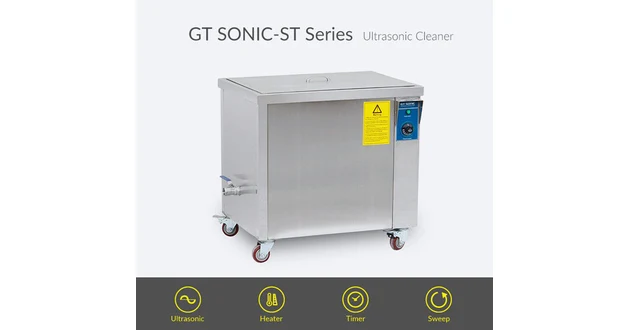
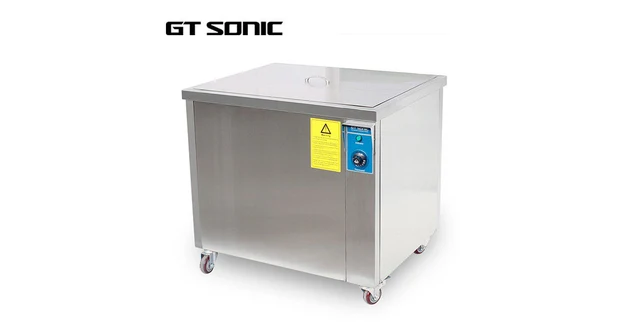
GT SONIC offers industrial ultrasonic cleaners in a range of capacities to accommodate different workpiece sizes and production requirements. The ST series includes models with 28kHz or 40kHz frequency configurations, adjustable ultrasonic power, and heating functions, giving manufacturers several options for industrial parts cleaning. A representative model is the GT SONIC 144L 28kHz/40kHz industrial ultrasonic cleaning machine, which combines 28kHz/40kHz capability with adjustable power and heating.
The table below compares four ST series models to illustrate how tank dimensions, ultrasonic power, and heating capacity vary across the range.
| Model | Tank Capacity | Internal Tank Dimensions (L x W x H) | Ultrasonic Power | Frequency Options | Heating Power |
|---|
| ST53A/B | 53L | 500 x 350 x 300 mm | 900W | 28kHz / 40kHz | 2000W |
| ST105A/B | 105L | 600 x 500 x 350 mm | 1500W | 28kHz / 40kHz | 4000W |
| ST144A/B | 144L | 600 x 600 x 400 mm | 1800W | 28kHz / 40kHz | 5000W |
| ST288A/B | 288L | 800 x 600 x 600 mm | 3000W | 28kHz / 40kHz | 7000W |
Specifications are based on published GT SONIC ST series information. Frequency configurations and final technical specifications should be confirmed for the selected model before ordering.
For smaller industrial batches, the ST53A/B provides a 53L cleaning tank, while the ST105A/B and ST144A/B offer additional space for larger components or increased batch quantities. The ST288A/B extends the range to 288L, making it an option for workpieces requiring substantially greater tank dimensions.
Across these models, the choice comes down to how the available cleaning space and equipment configuration fit the intended workload. Rather than selecting a machine solely by capacity or rated power, buyers can compare the specifications with their actual parts and processing requirements to narrow down the appropriate model.
For applications that require specific cleaning conditions or additional equipment features, GT SONIC can review the workpiece details and discuss suitable configurations before an order is placed.
What Information Should You Prepare Before Requesting an Industrial Ultrasonic Cleaner Quote?
Providing clear details about your cleaning application helps GT SONIC recommend a suitable machine and prepare a more accurate quotation. Before contacting the manufacturer, consider the following information:
| Information Required | Details to Provide |
|---|
| Workpiece Details | Material, dimensions, weight, and photos or drawings |
| Cleaning Requirements | Type of contamination and expected cleanliness level |
| Production Volume | Parts per batch and estimated daily cleaning quantity |
| Equipment Requirements | Voltage, heating, frequency, and other required functions |
| Order Requirements | Purchase quantity, customization needs, and destination country |
With these details, GT SONIC can help identify suitable industrial ultrasonic cleaner models and discuss any additional configuration requirements.
Frequently Asked Questions About Industrial Ultrasonic Cleaners
1. What size industrial ultrasonic cleaner do I need?
The right tank size depends on your largest workpiece, cleaning basket dimensions, and the number of parts processed per batch. Check the usable internal space rather than relying on nominal capacity alone. For regular production, also consider whether the equipment can handle your daily cleaning volume.
2. Is 28kHz or 40kHz better for industrial parts cleaning?
28kHz is generally suited to robust components with heavy grease or stubborn deposits, while 40kHz is commonly used for general industrial cleaning and applications requiring less aggressive cavitation. Neither frequency is suitable for every material. The choice should reflect the contamination type, surface condition, and required cleaning results.
3. How much ultrasonic power is needed for industrial cleaning?
Required ultrasonic power varies with tank capacity, workpiece loading, and contamination levels. Rated wattage and nominal power density provide useful comparison points, but they cannot fully predict cleaning performance. For demanding applications, evaluate the proposed equipment using representative parts and the intended cleaning conditions.
4. Do industrial ultrasonic cleaners need heating?
Not always. Heating can help remove certain oils and grease, particularly when combined with compatible water-based detergents. However, some materials and cleaning solutions require controlled or lower temperatures. The need for heating should be determined by the contaminants, cleaning chemistry, and workpiece compatibility.
5. How do I choose an industrial ultrasonic cleaner for continuous production?
Focus on required daily throughput, cleaning cycle time, and equipment suitability for repeated operation. Loading, rinsing, drying, and solution maintenance can all affect production capacity. For continuous or high-volume applications, confirm the machine's operating duty and whether additional handling or cleaning stages are necessary.
Conclusion
Choosing the right industrial ultrasonic cleaner comes down to matching the equipment with your workpieces, cleaning requirements, and production needs. Evaluating tank capacity, ultrasonic frequency, power, and essential functions can help you select a suitable machine while avoiding unnecessary costs.
GT SONIC offers industrial ultrasonic cleaners in various capacities and configurations. Contact GT SONIC to discuss your cleaning application and find the right solution for your business.


